

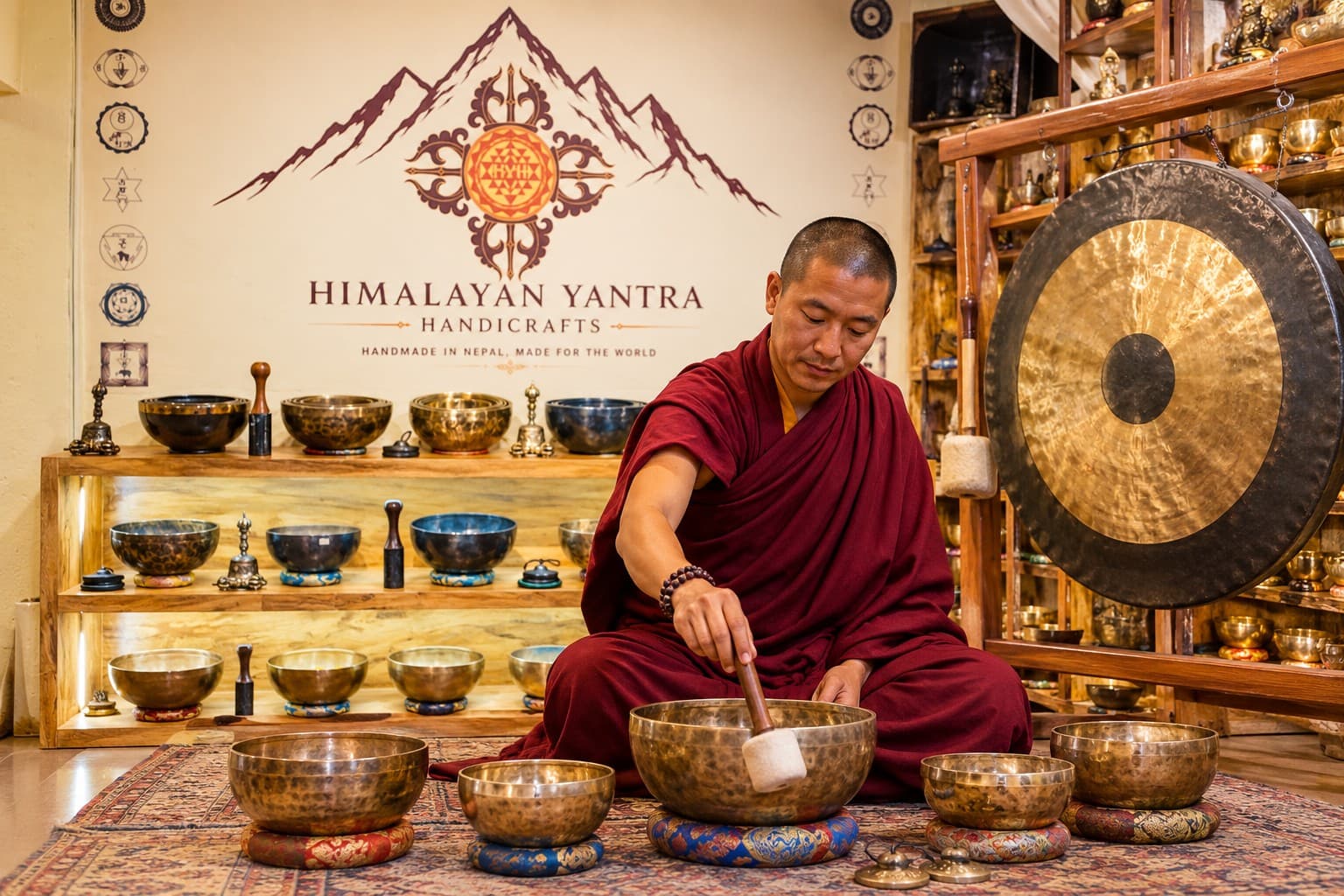
Sound Healing: A Complete Guide to Himalayan Singing Bowls, Gongs, and Sound Therapy
Are you interested in experiencing the power of sound healing? It has become part of human cultural, musical, contemplative, and spiritual practices for centuries. From the gentle resonance of Himalayan singing bowls to the deep vibrations of traditional gongs, sound-based practices offer a unique way to explore listening, relaxation, meditation, and mindfulness.
Today, sound healing has become a popular subject among yoga practitioners, meditation teachers, wellness enthusiasts, sound practitioners, and people interested in traditional musical instruments.
But what exactly is sound healing? How do singing bowls and gongs produce their distinctive sounds? What happens during a sound bath? And how can you choose the right sound healing instruments for personal practice or professional use?
At Himalayan Yantra Handicraft, located in Thamel, Kathmandu, Nepal, we work with Himalayan musical instruments and traditional handicrafts, including singing bowls, gongs, bells, tingsha, and other instruments used in sound-based practices.
This sound healing guide to Himalayan Singing Bowls, gongs, and sound therapy explores for you the principles, instruments, techniques, practical applications, and cultural context of sound healing to help beginners and experienced practitioners understand this fascinating field.
What is sound healing?
"Sound healing" is a simple way to describe practices that use sound, music, rhythm, and vibration as part of relaxation, meditation, mindfulness, and personal wellness.
These practices may involve Himalayan singing bowls, Tibetan-style bowls, gongs, tuning forks, bells, chimes, drums, and other musical instruments.
During a sound-based session, participants generally listen to different tones, rhythms, harmonics, and vibrations. Some sessions involve instruments being played around the room, while others may include singing bowls placed near or, with appropriate consent and precautions, on the body.
The experience can be quiet and meditative or involve a wider range of instruments and dynamic sounds.
Sound healing is also associated with the term sound therapy, although the two expressions can be used differently depending on the practitioner and context.
It is important to understand that sound-based wellness practices are not a substitute for medical diagnosis or treatment. Claims that a particular sound frequency cures diseases or guarantees physical healing should be approached critically.
How Does Sound Healing Work?
Sound is produced through vibration. When an instrument is struck, rubbed, or played, it creates vibrations that travel through the surrounding air as sound waves.
Our ears receive these sound waves, allowing the brain to interpret them as different tones, pitches, textures, and rhythms.
In a sound meditation or sound bath, practitioners create an environment in which participants can focus on listening and become more aware of their breathing and present experience.
Different instruments produce different acoustic characteristics.
For example:
- Singing bowls produce resonant tones with complex harmonics.
- Gongs can produce layered, evolving sounds and rich overtones.
- Tingsha creates bright, clear metallic tones.
- Bells produce focused, recognizable pitches.
- Drums introduce rhythm and rhythmic variation.
- Chimes create delicate and sustained sounds.
The combination of these instruments can create an immersive listening experience.
The experience is personal. Some people find it relaxing, while others enjoy the musical, meditative, or cultural aspects of the practice.
Himalayan Singing Bowls in Sound Healing
Handmade Himalayan singing bowls are among the most recognizable instruments associated with contemporary singing bowl training, sound healing, and meditation practices.
These bowl-shaped metal instruments are played using a wooden or padded mallet. Depending on the bowl and playing technique, they can produce sustained tones, harmonics, and changing acoustic textures.
Singing bowls are commonly used for:
- Meditation and mindfulness
- Yoga and relaxation
- Sound baths
- Group meditation
- Personal listening practice
- Contemporary sound-based wellness sessions
- Musical and cultural exploration
How Are Singing Bowls Played?
There are two common playing techniques for singing bowls:
1. Striking Technique
The player gently strikes the bowl using a suitable mallet. The bowl produces a resonant sound that gradually fades.
2. Rim-Rubbing Technique
The player moves a mallet around the outer rim using controlled pressure and speed. With practice, the bowl can produce a continuous singing tone.
Different bowls respond differently, so learning the appropriate playing technique is important.
What Makes Every Singing Bowl Different?
Choosing the best singing bowl is complex, but if you take advice from the sound healing export, you will get the best quality. Even bowls with similar appearances can have different sound characteristics.
Their acoustic response may depend on:
- Diameter and height
- Weight
- Wall thickness
- Shape
- Material and construction
- Rim formation
- Playing technique
For this reason, choosing a singing bowl should involve listening to the actual instrument whenever possible rather than relying only on its appearance or advertised frequency.
The Role of Gongs in Sound Healing
Gongs are another important category of sound healing instruments.
Unlike the singing bowls 7 chakra set, which generally produce a more focused resonant tone, gongs can create broad and evolving sound textures.
A gong may produce deep low-frequency components, bright overtones, complex harmonics, and changing waves of sound depending on its size, construction, and playing technique.
Gongs are commonly incorporated into:
- Professional Gong Master training course
- Gong baths
- Group sound meditation
- Yoga relaxation
- Contemporary sound therapy sessions
- Meditation workshops
- Musical performances
Different Types of Gongs
Planetary Gongs
These are often marketed with associations to planetary frequencies or numerical systems. Buyers should understand that such associations are interpretive systems, not proof of medical or astronomical effects.
Wind Gongs
Wind gongs are commonly known for their broad, shimmering sound and expressive response to playing.
Tam-Tam Gongs
Tam-Tam gongs can produce powerful, complex sound textures and are frequently used in orchestral and contemporary sound practices.
Burnmese Style Gongs
Burmese gongs, also known as nipple gongs, produce powerful sound and vibrations. Most of the sound healers and professional Gong training courses use Burmese gongs is best choice.
Chau Gongs
These traditional Chinese gongs have a distinctive raised central area and can produce a strong, focused sound.
When selecting a gong, consider diameter, weight, material, sound character, mallet compatibility, and the size of the space where it will be played.
What Is a Sound Bath?
A sound bath is a group or individual listening experience in which participants are surrounded by sounds created using musical and resonant instruments.
Despite its name, a sound bath does not involve water.
A typical sound bath may include:
- Participants settle into a comfortable resting position.
- The practitioner introduces the session and invites relaxed breathing.
- Singing bowls are played gently.
- Gongs and other instruments introduce additional sound textures.
- The practitioner gradually changes the rhythm, volume, and combination of instruments.
- The session concludes with a period of quiet.
A sound bath may last between 30 and 90 minutes, depending on the practitioner and session format.
Participants may experience relaxation, emotional responses, focused attention, or simply enjoyment of the sounds.
There is no requirement to experience a particular sensation for a session to be meaningful.
Benefits and Uses of Sound Healing
People explore sound healing for different personal and wellness purposes.
Some commonly reported reasons include:
1. Relaxation
Listening to gentle and sustained sounds can provide an opportunity to pause from daily activities.
2. Meditation
Singing bowls and gongs can serve as auditory points of focus during meditation.
3. Mindfulness
Paying attention to changing sounds can help practitioners develop present-moment awareness.
4. Yoga and Savasana
Yoga teachers may incorporate singing bowls and other instruments during relaxation or the closing part of a class.
5. Group Experiences
Sound baths create a shared listening environment for groups, retreats, and meditation workshops.
6. Musical Exploration
Learning to play different sound healing instruments can develop listening skills, rhythm, coordination, and musical sensitivity.
Individual experiences vary, and sound healing should not be presented as a proven cure for medical or psychological conditions.
Seven Chakra Singing Bowls and Sound Healing
Seven chakra singing bowl sets are popular among practitioners interested in combining sound meditation with the modern seven-chakra framework.
The commonly referenced seven chakras are
- Root Chakra – Muladhara
- Sacral Chakra – Svadhisthana
- Solar Plexus Chakra – Manipura
- Heart Chakra – Anahata
- Throat Chakra – Vishuddha
- Third Eye Chakra – Ajna
- Crown Chakra – Sahasrara
- Upper Crown Chakra—Bindu Chakra
Many contemporary seven-chakra bowl sets use different colors and decorative symbols to represent these energy centers.
Some sets also associate individual bowls with musical notes or frequencies.
However, there is no universally accepted scientific frequency for each chakra. A bowl's actual sound depends on its physical construction and how it is played.
Practitioners may use chakra bowls for meditation, visualization, relaxation, and chakra-focused contemplative practices.
What Is the Difference Between Sound Healing and Music Therapy?
Although the two practices may use sound and musical instruments, they are not identical.
Sound Healing
Sound healing is a broad wellness term for practices involving resonant instruments, listening, meditation, and relaxation.
Music Therapy
Music therapy is a professional healthcare discipline involving structured music-based interventions delivered by appropriately trained and qualified music therapists.
It is important not to confuse an informal sound bath with professional music therapy.
Essential Sound Healing Instruments for Beginners
If you are interested in starting a sound-based meditation practice, you do not need to purchase a large collection of instruments immediately.
A few carefully selected instruments can be enough to begin.
1. Himalayan Singing Bowl
A versatile instrument for meditation, relaxation, and sound exploration.
2. Gong
Tamtam and ABurmese gong both are useful for exploring deeper and more complex sound textures.
3. Tingsha
A pair of small metal cymbals commonly used to produce a clear, bright tone.
4. Tibetan-Style Bell & Dorje
Often incorporated into meditation and ritual contexts.
5. Chimes
Useful for adding delicate, light sounds to a session.
6. Sound Healing Mallets
Different mallets produce different acoustic responses. Selecting a suitable mallet is important for getting the desired sound from your instrument.
7. Bowl Cushions
Cushions provide support for singing bowls and help prevent unwanted contact with hard surfaces.
How to Choose the Right Sound Healing Instruments
Choosing instruments requires more than selecting attractive designs.
Consider the following factors before purchasing.
- Purpose: Decide whether you want instruments for personal meditation, yoga classes, sound baths, professional sessions, or musical performance.
- Sound: Listen to the actual instrument and consider its tone, resonance, harmonics, and response.
- Size: Larger instruments may require more space and can be heavier to transport.
- Craftsmanship: Examine the surface, construction, finishing, and overall condition.
- Accessories: Check whether mallets, cushions, stands, and protective cases are included.
- Budget: Compare actual specifications and craftsmanship rather than relying on price alone.
- Portability: Consider how you will transport and store your instruments.
For international buyers, product photographs, accurate dimensions, weight details, and sound demonstrations can make online purchasing more reliable.
Sound Healing in Nepal: Exploring Himalayan Musical Instruments
Nepal has a rich cultural landscape of traditional music, metal craftsmanship, religious art, and contemplative practices.
Kathmandu Valley, in particular, is known for its historic metalworking traditions and diverse cultural heritage.
Himalayan singing bowls, bells, gongs, and other instruments have become internationally recognized through their use in contemporary meditation and sound-based wellness practices.
For visitors interested in sound healing instruments in Nepal, Kathmandu provides opportunities to explore different instruments, compare their craftsmanship, and learn about their practical uses.
Thamel is one of the most convenient areas for travelers to discover Nepalese handicrafts and Himalayan musical instruments.
Where to Buy Sound Healing Instruments in Kathmandu?
If you are looking for a best place to buy singing bowls, gongs, or other sound healing instruments in Nepal, choosing a specialist store can help you understand the differences between individual products.
Himalayan Yantra Handicraft a best handicraft shop in Thamel is located in Thamel, Kathmandu, and offers Himalayan musical instruments and Nepalese handicrafts for local and international customers.
Our collection includes:
- Himalayan singing bowls
- Seven chakra singing bowl sets
- Meditation singing bowls
- Traditional and contemporary gongs
- Tam-Tam gongs
- Wind gongs
- Tingsha
- Tibetan-style bells
- Handpans
- Meditation accessories
Whether you are a beginner, yoga teacher, meditation practitioner, sound practitioner, collector, or traveler, we encourage you to explore the instruments and choose according to your actual needs.
We believe that customers should understand what they are purchasing, including the instrument's dimensions, weight, construction, sound characteristics, and included accessories.
Why Choose Himalayan Yantra Handicraft?
Based in Thamel, Kathmandu, Himalayan Yantra Handicraft connects Nepalese handicrafts and Himalayan musical instruments with customers around the world.
We focus on offering instruments for different interests and levels of experience, from personal meditation to professional sound-based practices.
Our approach emphasizes:
- A diverse selection of Himalayan musical instruments
- Singing bowls in different sizes and designs
- Gongs and sound meditation accessories
- Practical product information
- Opportunities to compare instruments
- Product photographs and sound demonstrations where available
- Support for international customers
- Shipping options for customers outside Nepal
Our goal is to make it easier for customers to discover Himalayan instruments while appreciating the craftsmanship and cultural context behind them.
Can You Learn Sound Healing?
Yes. People interested in sound healing can begin by learning how different instruments work and how to play them responsibly.
A beginner can start with a singing bowl and learn:
- Basic striking techniques
- Rim-playing techniques
- Sound awareness
- Instrument care
- Safe sound levels
- Basic meditation integration
- How to combine different instruments
More advanced learning may include gong playing, group sound bath facilitation, instrument combinations, session planning, and professional practice considerations.
Formal training should also address consent, hearing safety, professional boundaries, and the limitations of wellness claims.
Frequently Asked Questions About Sound Healing
What is sound healing?
Sound healing is a broad wellness practice involving sound, vibration, music, and resonant instruments for relaxation, meditation, mindfulness, and personal exploration.
Which instruments are used in sound healing?
Common instruments include Himalayan singing bowls, gongs, tingsha, bells, tuning forks, chimes, drums, and other resonant musical instruments.
What is the difference between a singing bowl and a gong?
Singing bowls generally produce focused resonant tones with complex harmonics, while gongs can produce broader, evolving sound textures and a wider range of acoustic responses.
What is a sound bath?
A sound bath is a listening experience in which participants relax while a practitioner plays instruments such as singing bowls, gongs, bells, and chimes.
Can beginners practice sound healing?
Yes. Beginners can start with one singing bowl, learn basic playing techniques, and gradually explore additional instruments.
How long does a sound bath last?
Many sound baths last between 30 and 90 minutes, although duration depends on the session and practitioner.
Are singing bowls used for chakra meditation?
Yes. Singing bowls are often used in contemporary chakra-focused meditation practices. Seven chakra sets commonly use colors and symbols associated with the seven-chakra model.
Where can I buy sound healing instruments in Nepal?
Himalayan Yantra Handicraft in Thamel, Kathmandu, offers Himalayan singing bowls, gongs, bells, tingsha, and other musical instruments, depending on availability.
Can I buy Himalayan singing bowls online from Nepal?
Yes. Before purchasing, ask for actual product photographs, dimensions, weight, sound demonstrations where available, shipping information, and return conditions.
Is sound healing a medical treatment?
Sound healing is generally described as a complementary wellness or contemplative practice. It should not replace professional medical care or be presented as a guaranteed treatment for illness.
Final Thoughts: Discover the World of Sound Healing
Sound healing brings together listening, musical expression, meditation, and cultural traditions through a wide range of instruments.
From the gentle resonance of a Himalayan singing bowl to the expansive sound of a gong, each instrument offers a different way to explore sound and personal practice.
Whether you are beginning your journey with a single meditation bowl or building a collection of professional sound healing instruments, take time to understand the sound, craftsmanship, and practical qualities of each instrument.
If you are visiting Nepal, explore the Himalayan musical instruments available in Thamel, Kathmandu.
Himalayan Yantra Handicraft in Thamel welcomes meditation practitioners, yoga teachers, sound practitioners, collectors, and travelers interested in discovering Himalayan singing bowls, gongs, and traditional Nepalese handicrafts.
Explore our collection and discover the world of Himalayan sound instruments from Nepal.