

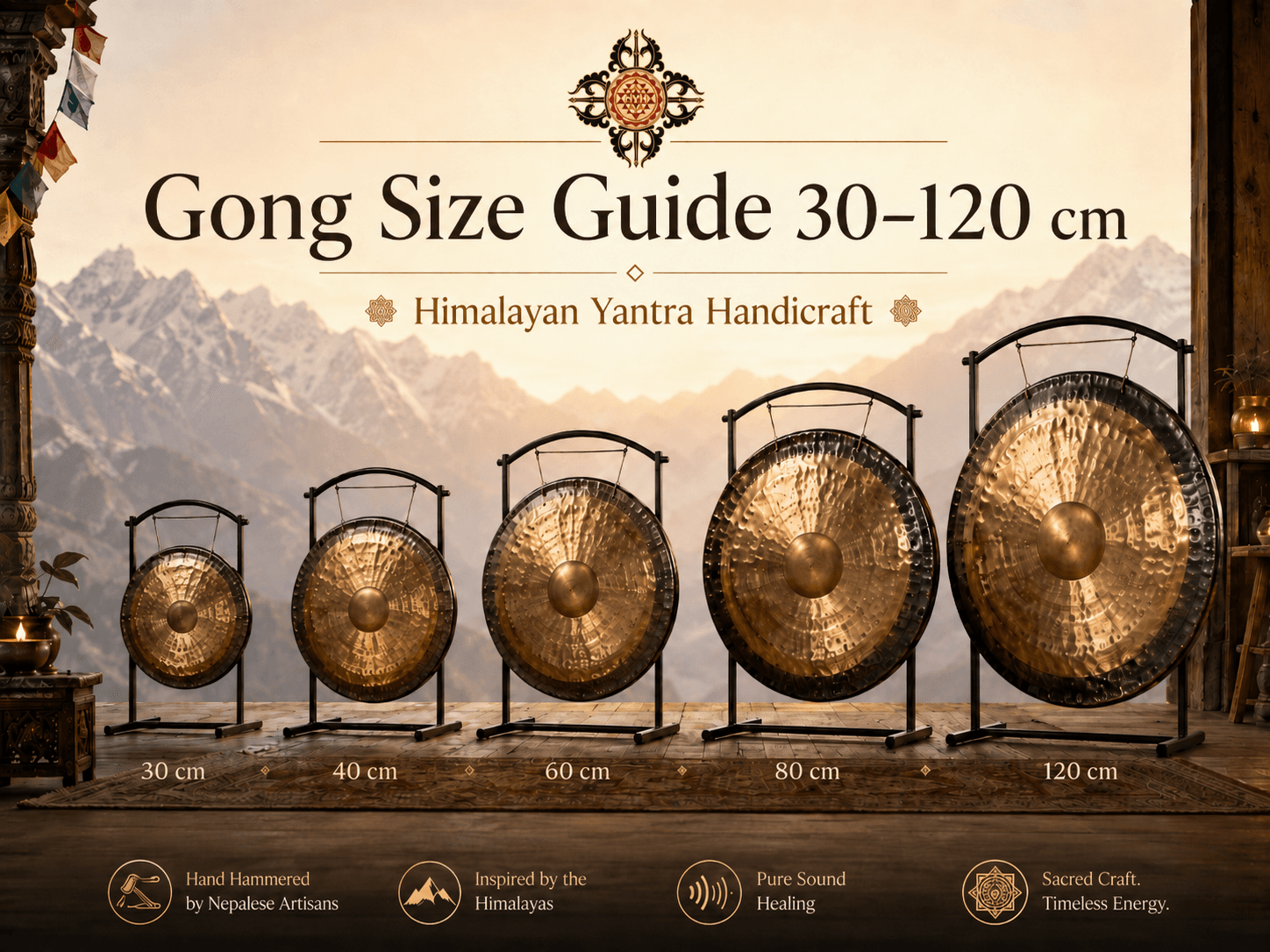
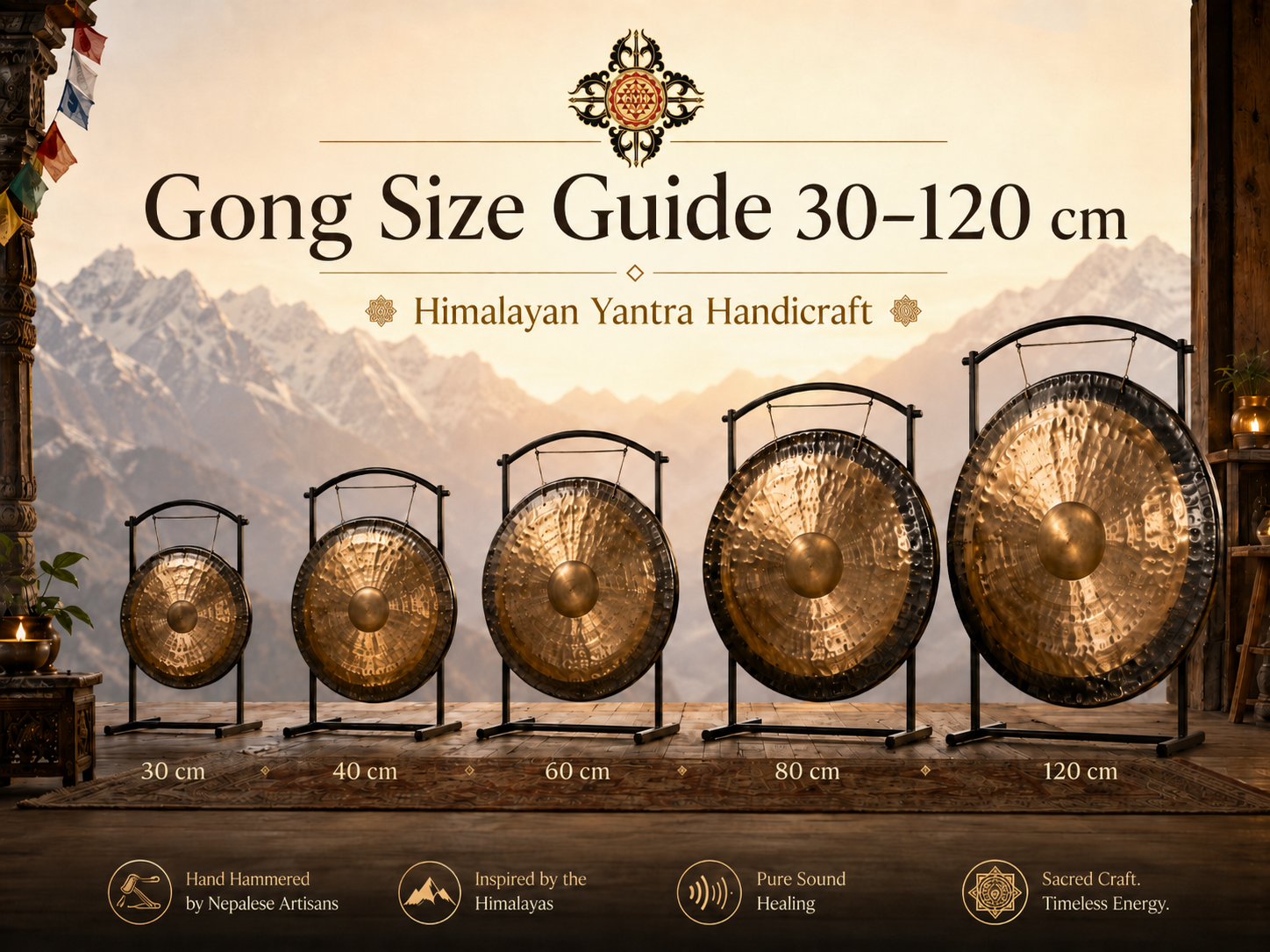
Choosing a sound healing gong is not simply a matter of buying the largest or most attractive instrument. Diameter, thickness, construction, hammering, shape, mallet choice, and playing technique all influence how a gong responds. A 30 cm gong may be ideal for travel, yoga classes, and personal meditation, while at the same time a 120 cm gong is designed to create an expansive field of sound for professional gong baths, retreats, and large wellness spaces.
At Himalayan Yantra Handicraft, a specialist sound-healing handicraft store in Thamel, Kathmandu, visitors can explore gongs, singing bowls, tingshas, bells, handpans, and other traditional healing instruments. Our focus is to help every customer choose an instrument according to sound quality and practical purpose—not size or appearance alone.
This complete gong size guide explains the characteristics of sound healing gongs from small 30 cm and 40 cm to large 120 cm, how each size may be used, what to listen for before buying, and why professional gong training in Nepal can be valuable for serious practitioners.
What Is a Sound Healing Gong?
A sound healing gong is a suspended metal percussion instrument played with one or more mallets to produce fundamental tones, overtones, pulses, and evolving waves of vibrations & resonance. Unlike an instrument intended to produce only one clean musical note, many healing gongs create a broad and changing spectrum of sound.
A gong belongs to the idiophone family because the body of the instrument itself vibrates when struck. Depending on its shape and construction, a single gentle stroke can develop from a low hum into shimmering upper harmonics and slowly return to silence.
This evolving sound is one reason gongs are commonly used in meditation, yoga, relaxation sessions, ceremonial practices, and group sound baths. The player can control the experience by changing the striking area, mallet size, rhythm, pressure, and space between strokes.
Professional gong manufacturers similarly explain that the instrument’s tone changes according to the striking point and the size, weight, and composition of the mallet. Different areas of a gong can reveal low tones, high tones, and mixtures of overtones.
How Gong Size Changes Tone, Volume, and Sustain
Gong diameter strongly influences its overall acoustic character. As a general principle, a larger instrument of comparable construction tends to produce a lower fundamental tone, greater volume, and longer sustain. However, gong size should never be treated as the only factor.
Thickness, curvature, rim design, metal alloy, hammering pattern, and weight can make two gongs of the same diameter sound very different. A thinner gong may respond quickly to a soft strike, while a heavier gong may require a larger mallet and more controlled force before its deeper voice develops.
Paiste’s acoustic guidance notes that larger cymbal-like instruments generally produce lower pitches and longer sustain, while thickness and physical profile also change pitch and response. Meinl similarly explains that gongs differ according to size, thickness, shape, material, and playing method.
For this reason, customers visiting Himalayan Yantra's gong shop in Thamel should listen to the individual instrument rather than selecting solely from a catalog description.
Gong Sizes from 30 cm to 120 cm: Quick Comparison
| Gong Size | Approximate Character | Protability | Recommended Use | Price in USD |
| 30 cm | Bright, direct, and responsive | Excellent | Travel, yoga classes, rituals | $160 |
| 40 cm | Clear with slightly fuller resonance | Excellent | Home meditation, space clearing | $250 |
| 50 cm | Balanced clarity and developing lower tones | Good | Beginners, small sound sessions | $390 |
| 60 cm | Deeper, richer, and more versatile | Moderate | Mobile sound healers, studios | $485 |
| 70 cm | Broad harmonics and stronger low tones | Moderate | Group relaxation, retreats | $655 |
| 80 cm | Immersive, layered, and room-filling | Limited | Professional gong baths | $940 |
| 90 cm | Deep bass and long sound development | Low | Retreat centres, larger groups | $1020 |
| 100 cm | Powerful, expansive, and sustained | Very low | Dedicated sound-healing spaces | $1350 |
| 110 cm | Large dynamic range and physical presence | Very low | Advanced practitioners | $3150 |
| 120 cm | Monumental, deep, and highly immersive | Permanent | Professional centres and events | $3450 |
These descriptions are practical guidelines rather than fixed tuning specifications. Every handmade gong has an individual acoustic identity.
30 cm Sound Healing Gong: Compact and Travel-Friendly
A 30 cm sound healing gong is one of the most portable choices for yoga teachers, meditation instructors, and traveling practitioners. Its compact size allows it to be carried more easily than a professional studio gong, particularly when protected in a padded case.
The tone of a 30 cm gong is generally brighter, more immediate, and less bass-heavy than that of a large gong. It responds quickly to a small mallet, making it useful for marking the beginning or end of meditation, introducing silence, clearing a room, or adding a short sound element to a yoga class.
A small gong is not normally intended to create the same enveloping low-frequency experience as an 80 cm or 100 cm gong. Its strength lies in clarity, convenience, and controlled use in smaller spaces.
Best for:
- Travelling yoga teachers
- Meditation bells and transitions
- Home altars
- Reiki rooms
- Small ceremonies
- Office or treatment-room space clearing
40 cm Gong for Meditation and Yoga Classes
A 40 cm gong provides greater tonal body than a 30 cm model while remaining compact enough for regular transport. It is a practical choice for a home meditation room, yoga studio, wellness treatment room, or small spiritual center.
This size can produce clearer midrange tones and a slightly longer decay than many smaller gongs. With a soft mallet, the player can create gentle waves without overwhelming participants in a confined room.
For beginners searching for a small gong for meditation, a 40 cm gong can offer a comfortable balance between affordability, portability, and resonance.
Best for:
- Personal meditation
- Yoga class openings and closings
- Small group relaxation
- Massage or Reiki rooms
- Mindfulness practices
- Ceremonial use
50 cm Healing Gong: A Practical Beginner Size
The 50 cm healing gong is an excellent transition between a compact meditation gong and a full professional gong bath instrument. At this size, the sound begins to develop more noticeable depth, body, and harmonic complexity.
A well-made 50 cm gong can work for personal practice, small workshops, and mobile sound-healing sessions. It remains manageable for transportation while offering enough resonance to introduce students to basic gong-playing techniques.
For a beginner visiting Himalayan Yantra to buy a gong in Kathmandu, the 50 cm option is often worth testing alongside 40 cm and 60 cm instruments. Listening to all three makes it easier to understand how quickly the tonal character changes with diameter.
Best for:
- First-time gong owners
- Small sound baths
- Mobile wellness practitioners
- Yoga and meditation teachers
- Home healing rooms
- Sound-healing demonstrations
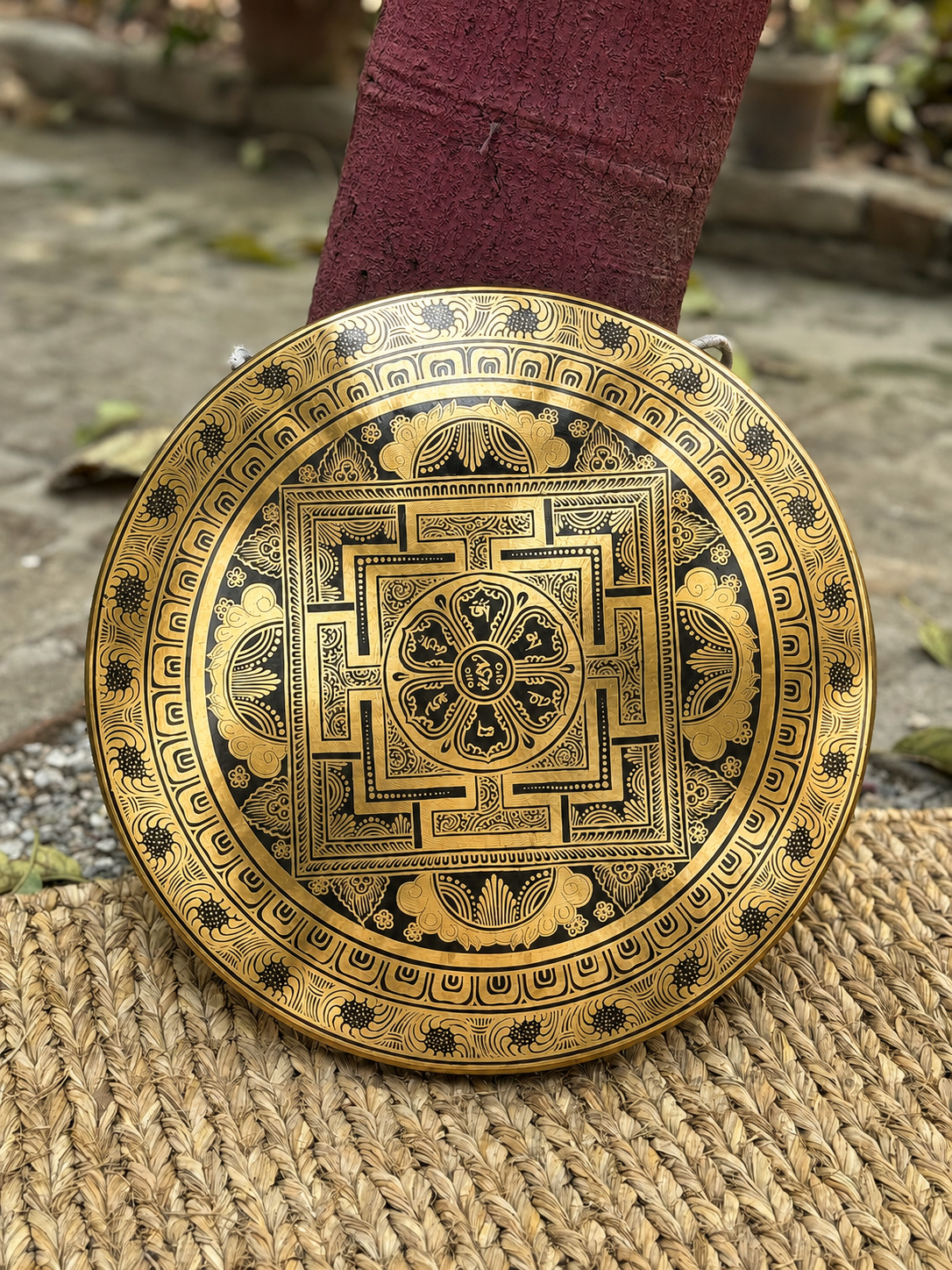
60 cm Sound Healing Gong: Balanced and Versatile
A 60 cm sound healing gong is one of the most versatile options for practitioners who require portability but also want a fuller sound. It can produce a balanced combination of lower tones, midrange resonance, and brighter overtones.
This size is suitable for people beginning professional sound work because it can be played gently in a small room or developed into a broader wave for medium-sized groups. It also blends effectively with singing bowls, tingshas, bells, handpans, and other healing instruments.
A suitable stand and more than one mallet will help the practitioner explore the instrument properly. A larger soft mallet can activate the lower body of the gong, while a smaller mallet can bring forward clearer upper tones.
Best for:
- Mobile sound healers
- Small and medium gong baths
- Yoga studios
- Wellness centres
- Retreat sessions
- Integration with singing bowls
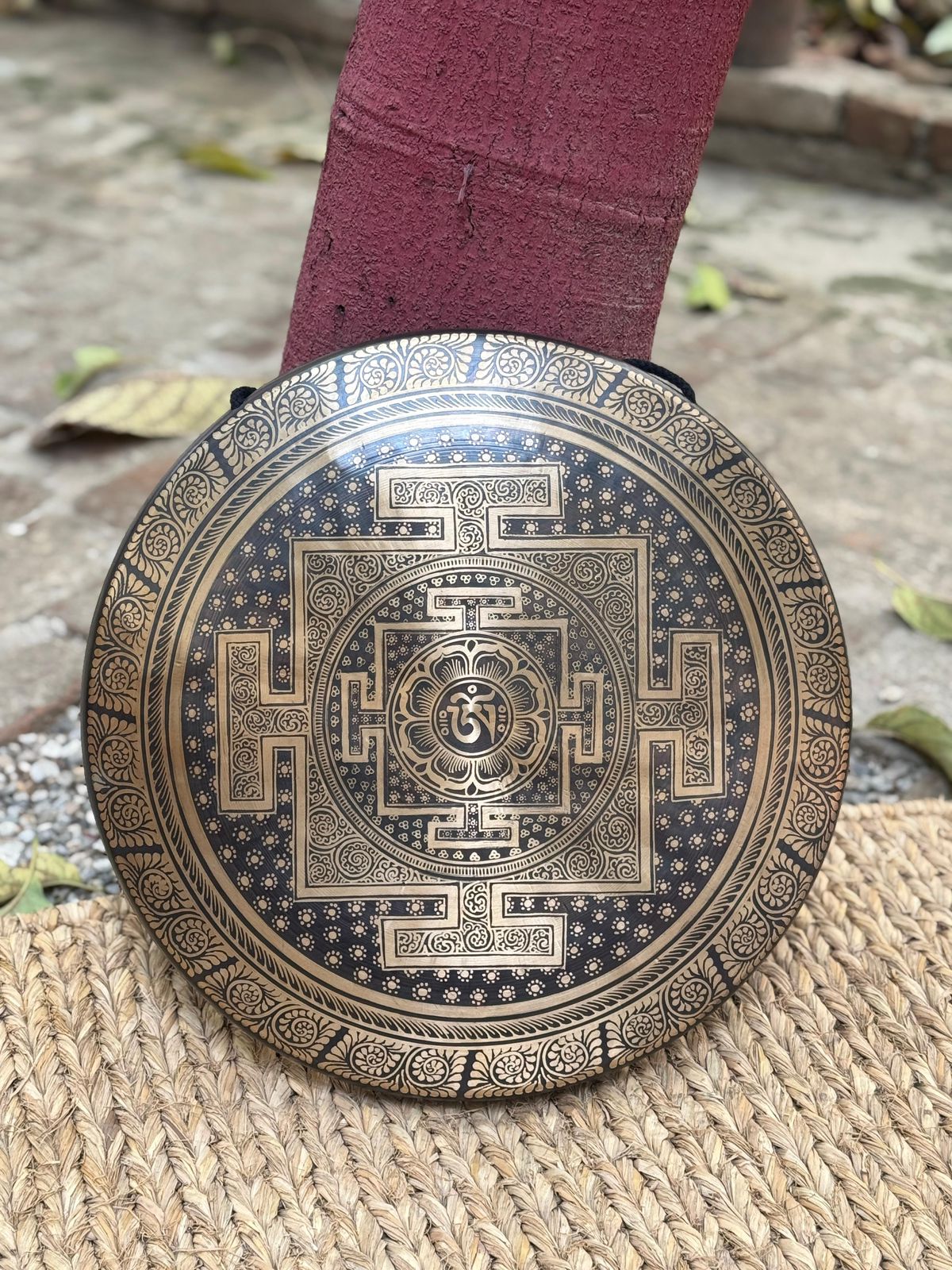
70 cm Gong for Group Sound Healing
The 70 cm gong enters a more immersive acoustic category. Its larger surface allows a broader spectrum of sound to develop, including stronger low tones and increasingly complex overtone interactions.
A well-played 70 cm gong can fill a medium-sized meditation room without requiring aggressive strikes. It is suitable for practitioners who have learned to build volume gradually and understand how to create waves without startling participants.
This size is also attractive for retreat centers and sound-healing studios that need a professional presence but do not have space for a 100 cm or 120 cm instrument.
Best for:
- Group relaxation sessions
- Retreat centres
- Professional yoga studios
- Medium-sized gong baths
- Meditation events
- Sound-healing training practice
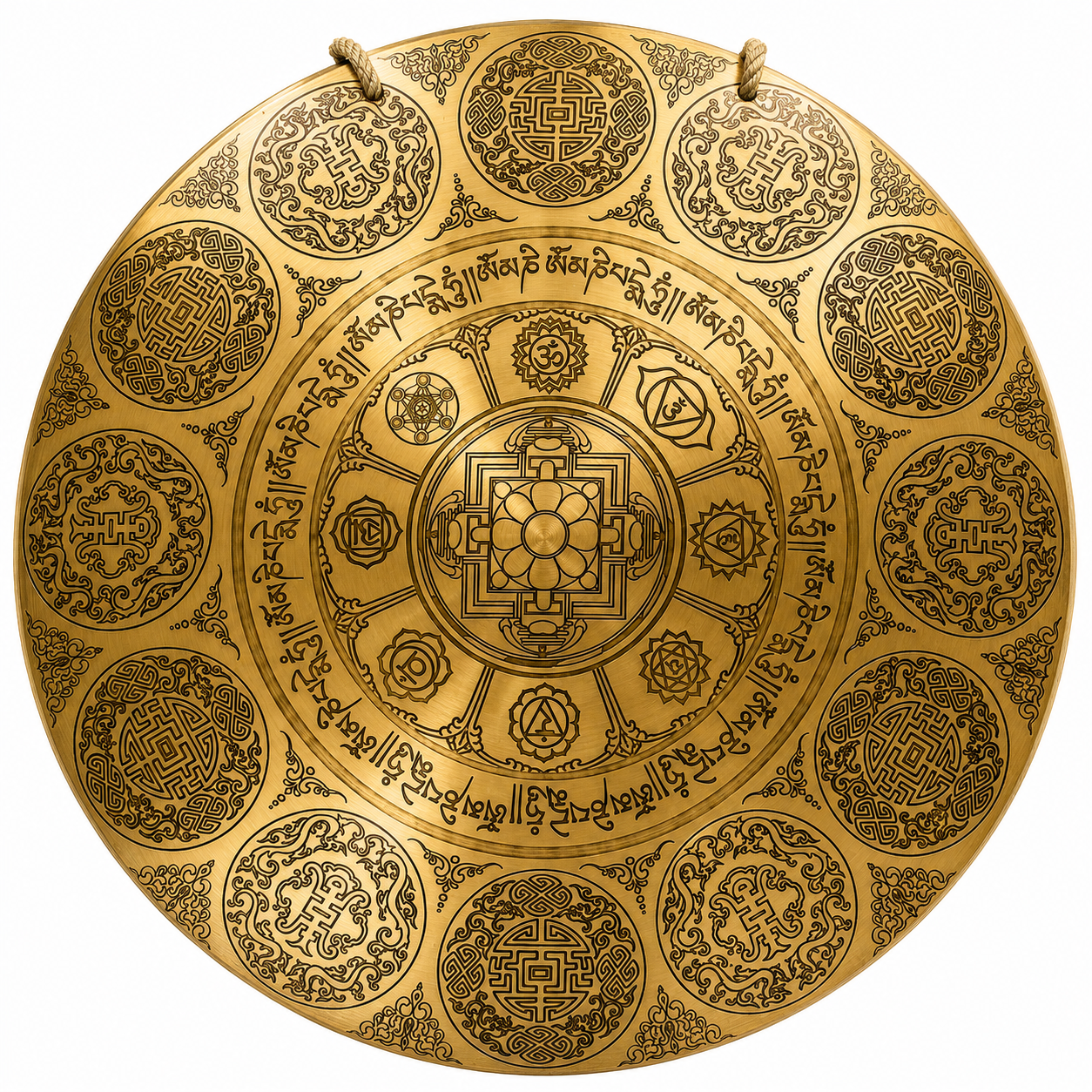
80 cm Professional Gong for Sound Baths
An 80 cm professional gong offers a wide tonal field, substantial resonance, and a more physical presence in the room. At this diameter, participants may experience sound as both an audible and spatial event, particularly when the instrument is played with controlled dynamics.
This size requires a stable stand, sufficient room around the instrument, and appropriate training. The player should understand how to awaken the gong gradually, maintain a comfortable volume, and allow the instrument’s existing resonance to develop before adding another stroke.
Professional gong makers offer instruments around this diameter because it provides significant tonal range without reaching the extreme size and transportation requirements of 110 cm or 120 cm gongs.
Best for:
- Professional gong baths
- Sound-healing studios
- Yoga retreats
- Group meditation
- Wellness events
- Experienced sound practitioners
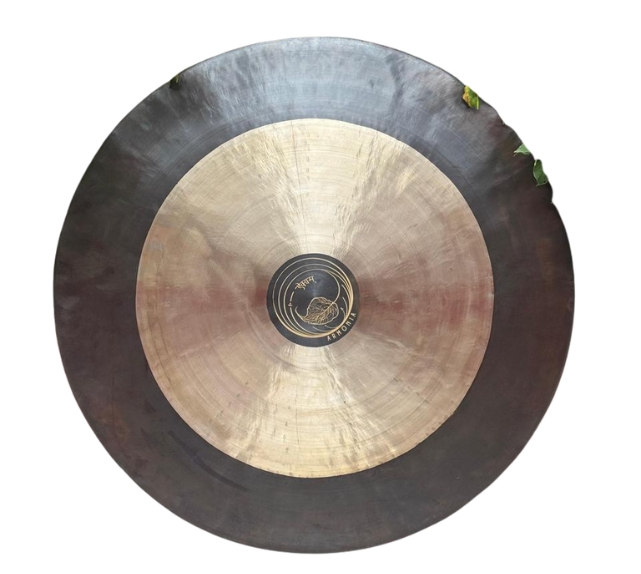
90 cm Large Gong for Retreat Centres
A 90 cm gong produces a deeper and more sustained acoustic environment than most medium-sized instruments. It can create powerful low tones, rolling harmonic movement, and long transitions into silence.
This gong size is more suitable for a semipermanent or permanent installation. Transportation requires planning, and the stand must support the weight while allowing the gong to hang freely.
In a retreat center or professional studio, a 90 cm gong can become the central instrument around which singing bowls, bells, chimes, tingshas, and handpans are arranged.
Best for:
- Retreat halls
- Large yoga studios
- Professional sound journeys
- Group meditation programmes
- Ceremonial events
- Advanced gong practitioners
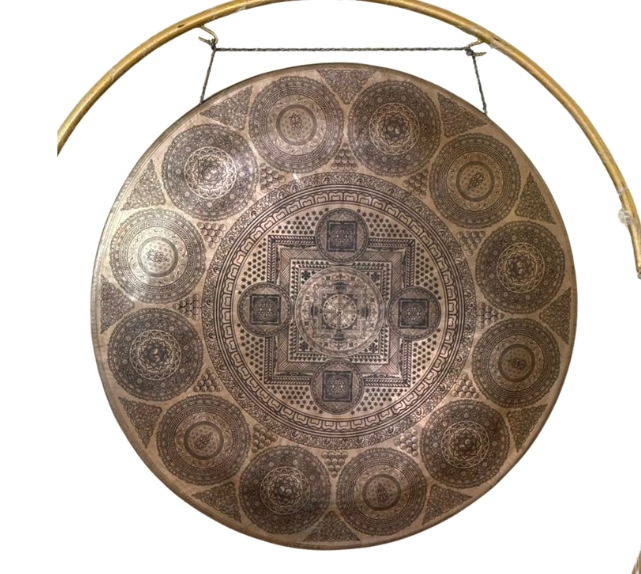
100 cm Gong for Professional Healing Spaces
A 100 cm sound healing gong creates a substantial visual and acoustic presence. It is intended for practitioners who understand pacing, dynamics, mallet selection, and participant safety. The large vibrating surface can produce extended low-frequency resonance and a wide range of upper harmonics. It should not be played hard simply because it is large. In many situations, gentle and patient playing creates a richer experience than repeated forceful strikes.
A 100 cm gong is generally best placed in a dedicated sound room, retreat center, yoga hall, or professional healing studio where it can remain correctly suspended.
Best for
- Professional sound-healing centres
- Large retreat groups
- Dedicated gong studios
- Meditation halls
- Sound performances
- Advanced facilitator training
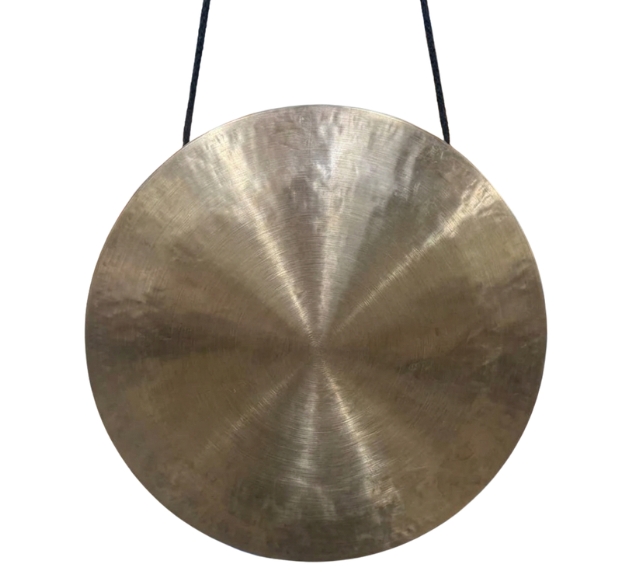
110 cm Gong for Advanced Practitioners
A 110 cm professional gong offers an extensive dynamic range. It can move from a nearly inaudible hum to a powerful room-filling resonance, but controlling that journey requires sensitivity and practice.
This size needs a high-quality stand, correctly positioned suspension cords, suitable mallets, and generous playing space. The gong should have enough clearance to move naturally without hitting the frame.
For advanced gong practitioners, a 110 cm instrument may become a primary tool for longer sound journeys, ceremonial work, and large-group meditation.
Best for:
- Advanced gong masters
- Large retreat facilities
- Sound-healing schools
- Ceremonial halls
- Professional events
- Permanent studio installations
120 cm Gong: Maximum Depth and Immersive Resonance
A 120 cm gong is a flagship professional instrument. Its enormous surface can create deep fundamental tones, broad harmonic movement, and exceptionally long sustain.
Large 120 cm gongs are available from established gong makers, and manufacturers describe this diameter as capable of low-pitched sound, wave-like overtones, a wide tonal spectrum, and long sustain.
This size is not recommended simply because someone wants the “most powerful” gong. A 120 cm instrument requires an appropriate room, a professional stand, several suitable mallets, and a practitioner capable of controlling volume and intensity.
When played with patience, a large gong can develop sound gradually without being harsh. When played without skill, the same instrument may become unnecessarily loud or uncomfortable.
Best for:
- Professional gong-training centres
- Large sound baths
- Retreat halls
- Yoga and meditation festivals
- Permanent sound-healing studios
- Highly experienced gong facilitators
Which Gong Size Is Best for You?
Best Gong Size for Home Meditation
- For home meditation, consider a gong between 30 cm and 50 cm. These sizes are easier to place, store, and play at a comfortable volume.
- A 40 cm or 50 cm gong generally offers enough resonance for regular practice without requiring a large professional stand or dedicated hall.
Best Gong Size for a Yoga Teacher
- Yoga teachers who travel between studios may prefer 30 cm to 50 cm. Teachers working permanently in one studio may consider 50 cm to 70 cm for a fuller relaxation experience.
- The gong can be used to open a class, support savasana, mark meditation periods, or conclude a workshop.
Best Gong Size for a Mobile Sound Healer
- A mobile sound healer will usually need to balance resonance with transportation. Sizes between 50 cm and 70 cm are practical options, depending on the practitioner’s vehicle, stand, and supporting instruments.
Best Gong Size for Professional Gong Baths
- Professional facilitators commonly benefit from gongs around 70 cm to 100 cm, although the correct choice depends on room size, group size, and playing experience.
- One high-quality gong played skillfully is more valuable than several instruments played without control.
Best Gong Size for a Retreat Centre
- Retreat centres with dedicated sound rooms may consider 80 cm to 120 cm. Larger gongs create a strong visual center and can serve group meditation, sound baths, ceremonies, and training programs.
Types of Sound Healing Gongs
Tamtang or Chau Gong
- A tam-tam gong, also called a Chau gong or tam-tam in different markets, usually has a turned rim and a darker central and outer area. It can produce low humming tones, complex overtones, and dramatic crescendos.
- This style is versatile for gong baths, performances, ceremonies, and professional sound work. Himalayan Yantra’s gong collection includes Tamtang gongs across a broad size range.
Wind Gong or Feng Gong
- A wind gong is generally flatter and more flexible than a rimmed Chau-style gong. It responds quickly and can create shimmering, wave-like overtones.
- Official product descriptions from Meinl note that flat-wind gongs can open into a wide tonal spectrum with long sustain, with lower tones dominant during soft playing and wave-like overtones emerging as the intensity grows.
Bossed or Nipple Gong
- A nipple gong (Burmese-style gong) has a raised center that produces a more focused pitch. These instruments are common in several Asian musical and ceremonial traditions.
- They are useful when a practitioner wants a more defined central tone rather than the broad, unpredictable wash associated with many flat or rimmed gongs.
Symphonic Gong
- A symphonic gong is designed to provide a balanced relationship between the fundamental tone and complex overtones. The player can explore different tonal areas through striking position and mallet choice.
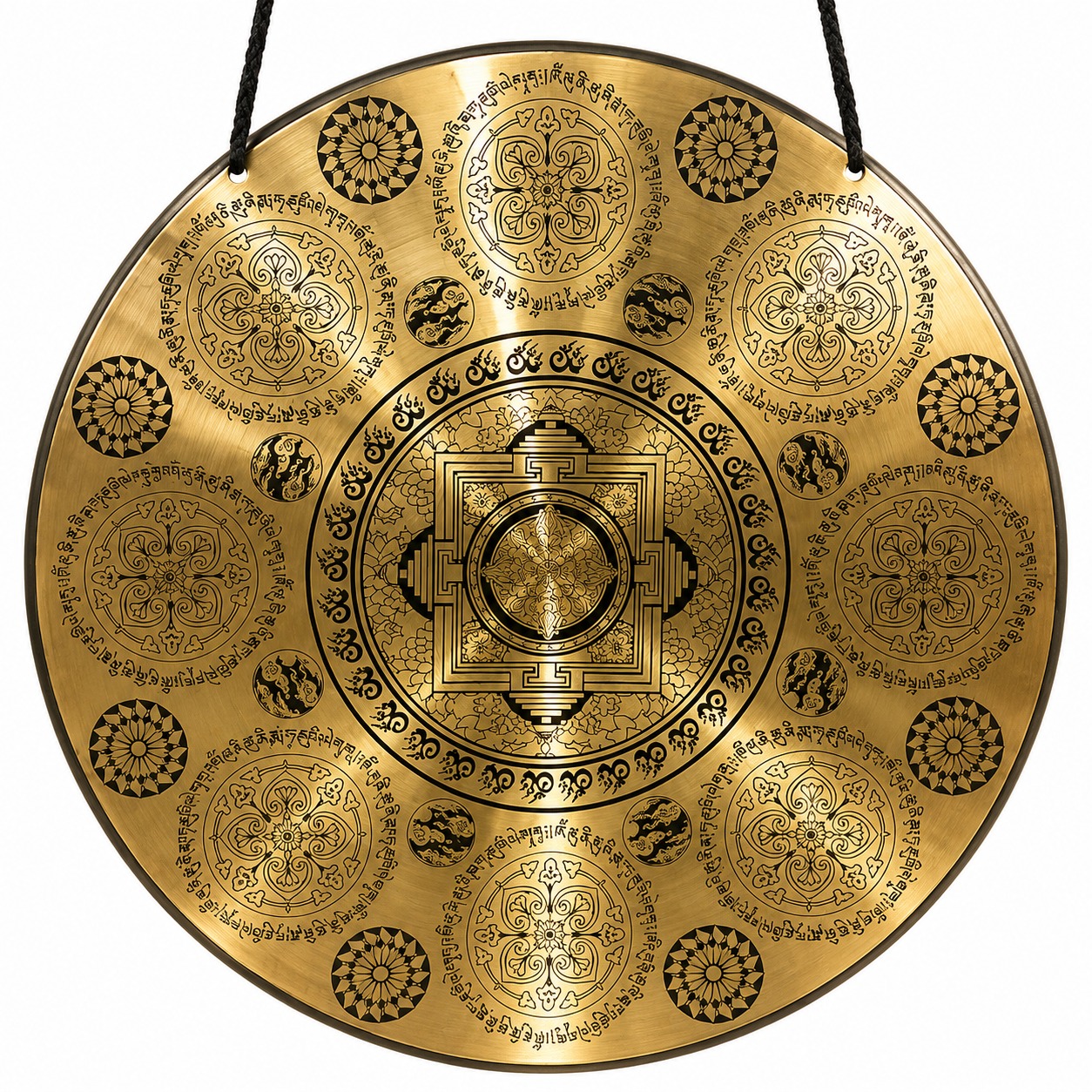
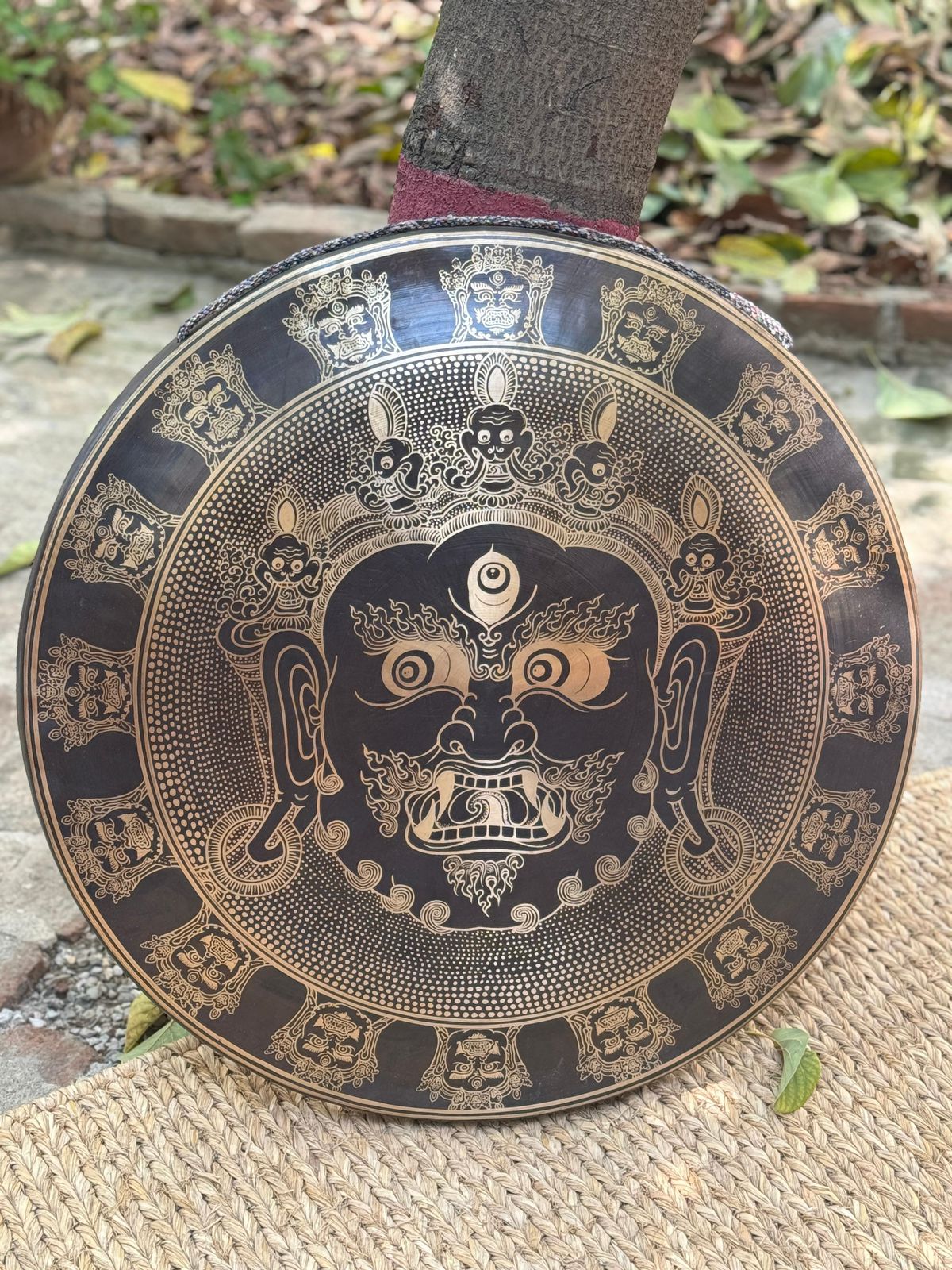
Mantra and Decorative Gongs
- Mantra gongs may feature sacred symbols, Buddhist mantras, yantras, or traditional artwork. These designs add cultural and visual meaning, but customers should still judge the instrument by its sound, construction, and sustain.
Decoration should complement acoustic quality rather than hide poor craftsmanship.
Hand-Hammered Gong vs. Machine-Made Gong
- A hand-hammered gong normally shows subtle variations in its surface. These marks reflect repeated shaping and tuning rather than a perfectly uniform factory finish.
- Handcrafting does not automatically guarantee that every gong will sound excellent. The instrument must still be tested for response, tonal balance, unwanted rattling, cracks, suspension quality, and sustain.
- Machine-produced gongs may offer consistency and affordability, but handmade instruments are often selected by practitioners seeking a more individual tonal character and visible artisan craftsmanship.
When buying a handmade gong in Nepal, always ask these questions to sellers.
- What metal or alloy is used?
- Was the gong hand-hammered or pressed?
- Is the gong individually sound-tested?
- Is the mallet included?
- Is a suitable stand available?
- Is a protective case available?
- Can the actual gong be heard before purchase?
- How will it be packed for international shipping?
How to Test a Gong in a Thamel Handicraft Store
People searching for the best gong seller in Thamel should look beyond signs, discounts, and decorative designs. A specialist sound-healing store should allow customers to understand how the instrument actually responds.
Begin with a gentle strike using a soft mallet. Listen to the initial tone, then follow the sound as it expands and fades. A good gong should not need excessive force to become expressive.
Next, test different areas of the gong. Striking closer to the inner area may reveal deeper tones, while controlled playing nearer the outer section may bring forward brighter harmonics. Exact results vary according to gong design.
Listen for:
- A smooth initial attack
- Balanced resonance
- Gradually developing overtones
- Useful sustain
- No metallic buzzing from loose fittings
- No visible cracks
- Strong suspension cords
- A sound that feels suitable for your purpose
At Himalayan Yantra Handicraft in Thamel, customers can compare multiple sound healing instruments rather than choosing from photographs alone. Online buyers should request a clear sound sample of the exact gong whenever possible.
Choosing the Correct Gong Mallet
A gong mallet is not a minor accessory. Its head size, softness, weight, and handle length can completely change the instrument’s response.
A large, soft mallet generally brings out lower and warmer tones. A smaller or firmer mallet may produce a more immediate attack and brighter frequencies. Some professional players use friction mallets or specialized tools to create continuous singing tones.
The mallet should match the gong size. A very small mallet may fail to awaken the low voice of a 100 cm gong, while an oversized mallet may make a 30 cm gong difficult to control.
Professional manufacturers also state that the nature of the stroke and the mallet’s size, weight, and composition influence the resulting sound.
Gong Stand, Case, and Essential Accessories
Every medium- or large-sized sound healing gong requires a stable stand that lets the instrument swing and vibrate freely.
A proper setup may include:
- Gong stand
- Suspension cord
- Main soft mallet
- Secondary mallet
- Protective gong cover
- Padded travel case
- Mallet storage bag
- Microfiber cleaning cloth
- Floor protection under the stand
The stand must be larger than the gong and should provide enough clearance around the edges. Framed stands are specifically designed to let a suspended gong move freely while it is played.
How Gongs Are Used in Sound Healing
During a gong bath, participants usually sit or lie comfortably while a trained facilitator develops a sound journey. The session may begin with silence, breathing, gentle bells, or singing bowls before the gong is gradually introduced.
The player normally builds intensity in stages rather than beginning at full volume. Periods of resonance are balanced with pauses so participants can experience both sound and silence.
Gongs may be combined with:
- Himalayan singing bowls
- Tingsha cymbals
- Ghanta bells
- Handpans
- Chimes
- Drums
- Shruti boxes
- Mantra chanting
- Guided breathing
- Meditation
Sound healing is best presented as a supportive wellness and contemplative practice, not as a replacement for medical or psychological treatment.
Gong Bath Benefits: What Research Suggests
Many people attend gong baths and sound meditations for relaxation, focused awareness, and relief from everyday tension. Research into sound-based interventions is developing, but it remains more limited than research into established clinical treatments.
A study of 62 participants attending a sound meditation with singing bowls and other instruments reported reduced tension, anger, fatigue, and depressed mood after the session. However, the study design does not prove that gongs or particular frequencies directly caused every reported change.
A broader 2024 review found growing interest in sound interventions and possible stress-related benefits, while also highlighting variation in methods and the need for stronger research. Medical sources similarly describe the evidence for sound baths as promising but still inconclusive.
Responsible gong practitioners should therefore avoid claims that gong sound can cure diseases, repair cells, eliminate trauma, or replace professional healthcare. A more trustworthy description is that gong sessions may support relaxation, meditation, emotional reflection, and a temporary reduction in perceived stress for some participants.
Gong Safety and Responsible Playing
A sound healing gong should be played at a comfortable volume. Bigger does not mean that the instrument must be played louder.
Participants should be encouraged to move farther away, sit up, or leave the session if they feel discomfort. People with tinnitus, hyperacusis, migraines, hearing sensitivity, trauma-related sound triggers, or other health concerns should inform the facilitator before the session.
Pregnant participants and people with significant neurological, cardiac, or hearing conditions should seek appropriate professional guidance when uncertain.
The gong should never be placed extremely close to a participant’s head, and facilitators should avoid sudden uncontrolled strikes.
Gong Training in Nepal: Learn More Than Striking Techniques
Buying a professional gong is only the beginning. A skilled practitioner must learn how to control rhythm, volume, striking zones, mallet selection, silence, and the emotional atmosphere of a session.
Professional gong training in Nepal may cover:
- History and types of gongs
- Basic acoustic principles
- Gong anatomy
- Mallet selection
- Striking zones
- Volume control
- Gong warming techniques
- Building and releasing crescendos
- Creating balanced sound journeys
- Combining gongs with singing bowls
- Participant positioning
- Session preparation
- Contraindications and safety
- Personal meditation with gong
- Group gong-bath facilitation
- Care, storage and transportation
Himalayan Yoga Academy currently presents a three-day Professional Gong Master Training in Nepal and describes the program as an intensive training connected with Nada Yoga and sound practice.
Visitors can therefore begin their journey by exploring and testing instruments at Himalayan Yantra Handicraft in Thamel, then deepen their practical knowledge through professional gong master training in Kathmandu.
Why Study Gong and Sound Healing in Nepal?
Nepal offers a distinctive environment for studying meditation, yoga, mantra, Buddhist ritual, traditional metalwork, and sound practice. Kathmandu Valley is home to active artisan communities, monasteries, temples, yoga schools, and sound-healing practitioners.
Learning in Nepal gives international students the opportunity to connect the instrument with a broader cultural context. A good program should still distinguish between traditional practices, modern wellness methods, and scientific evidence rather than blending all three without explanation.
Students should choose gong training based on curriculum quality, teacher experience, practical hours, safety education, instrument access, and honest certification information.
Why Buy a Gong from Himalayan Yantra Handicraft in Thamel?
Himalayan Yantra Handicraft specializes in sound healing products, including gongs, singing bowls, tingshas, bells, handpans, and related accessories. This specialist focus helps customers compare instruments designed for meditation, wellness practice, ceremony, and professional sound sessions.
Customers looking for a sound healing instrument shop in Thamel can benefit from:
- In-person sound testing
- Multiple gong sizes
- Guidance based on intended use
- Access to matching mallets and stands
- Knowledge of singing bowls and supporting instruments
- Packing assistance for international customers
- Connections with professional gong training in Nepal
- Direct communication with a Kathmandu-based seller
Instead of claiming that one instrument is universally best, Himalayan Yantra helps buyers identify the gong that best matches their room, experience, travel requirements, and sound preference.
How to Care for a Sound Healing Gong
Keep the gong suspended safely when in use and covered when stored. Dust can be removed with a soft, dry microfiber cloth.
Avoid abrasive scrubbers and aggressive household chemicals unless the gong maker has confirmed that they are safe for the specific finish. Strong polishing products may alter patina, printed designs, or surface appearance.
Do not lift a large gong by pulling only one section of its cord. Support it carefully and inspect the suspension system regularly.
For transportation:
- Remove the gong from the stand.
- Place it in a padded cover.
- Protect both faces from pressure.
- Keep mallets in a separate compartment.
- Avoid stacking heavy objects on the gong.
- Recheck the cords before rehanging them.
Frequently Asked Questions about Sound Healing Gongs
What size gong is best for a beginner?
A 40 cm, 50 cm, or 60 cm gong is a practical starting point. These sizes are manageable while offering enough tonal range for learning basic techniques.
Is a bigger gong always better for sound healing?
No. A larger gong generally offers deeper tones and longer sustain, but it also requires more space, a stronger stand, larger mallets, and greater playing control.
Which gong size is best for a professional gong bath?
Gongs between 70 cm and 100 cm are common practical choices for professional sessions. Large centres may use instruments up to 120 cm.
Can I travel internationally with a gong?
Smaller gongs are easier to transport. For medium and large instruments, use a padded case and confirm baggage or cargo restrictions before traveling.
What is the difference between a gong and a singing bowl?
A singing bowl usually produces a more focused tone and may be struck or played around its rim. A gong creates a broader, evolving sound field with complex harmonics and greater room-filling potential.
Can a gong be used with singing bowls?
Yes. Gongs and singing bowls complement each other. Bowls can provide focused tones, while the gong creates broad transitions, crescendos, and immersive layers.
Where can I buy a gong in Kathmandu?
Himalayan Yantra Handicraft is a specialist sound-healing handicraft store in Thamel, Kathmandu, offering gongs and other meditation instruments for local and international customers.
Where can I learn professional gong playing in Nepal?
Professional gong master training in Nepal is available through Himalayan Yoga Academy in Kathmandu. Students can combine practical training with instrument selection through Himalayan Yantra Handicraft.
Can I order a Himalayan gong online?
Yes. Before ordering, request the diameter, weight, material, accessories, shipping method, and a recording of the actual instrument whenever available.
Conclusion: Choose Your Gong by Sound, Space and Purpose
The best sound healing gong is not automatically the biggest, most expensive, or most decorative instrument. It is the gong whose sound, response, size, and practical requirements align with the person who will play it.
A 30 cm gong may become a meaningful companion for a traveling yoga teacher. A 60 cm gong may serve a mobile sound healer for years. An 80 cm gong may become the center of a professional studio, while a 120 cm gong may transform a large retreat hall into an expansive field of sound.
At Himalayan Yantra Handicraft, our goal is to help customers understand these differences before purchasing. Visit our sound healing instrument store in Thamel, Kathmandu, to explore gongs from 30 cm to 120 cm, compare tones, select suitable accessories, and learn about professional gong training in Nepal.
Choose patiently. Listen closely. The right gong should not merely look impressive—it should invite you to continue listening after the final vibration has disappeared.