

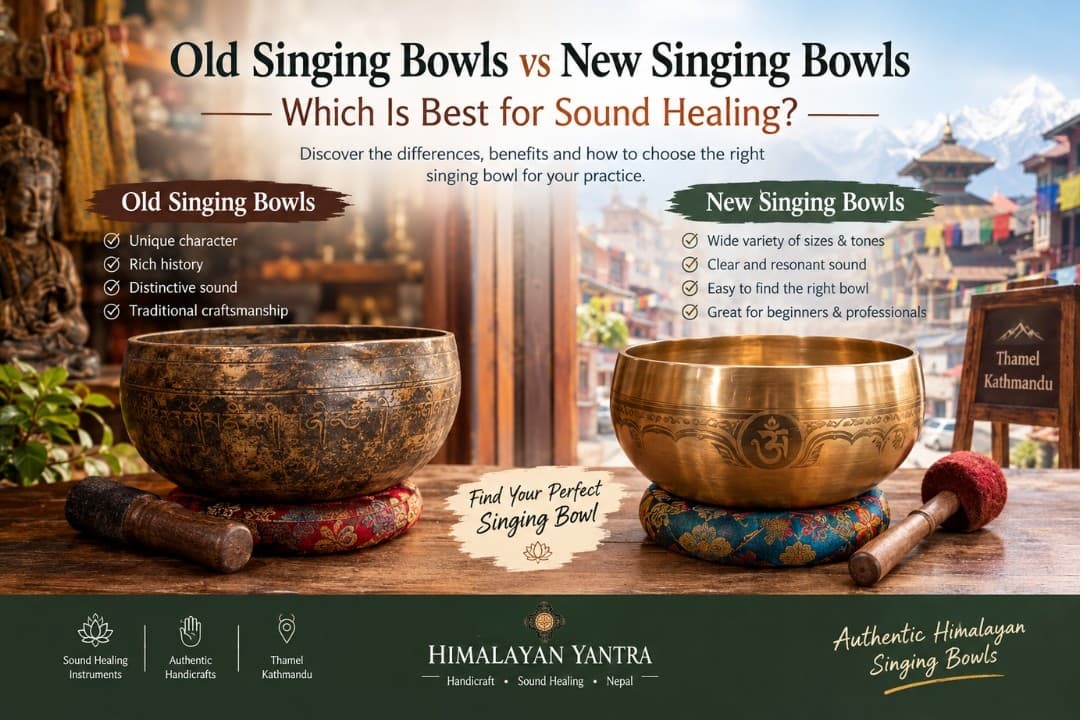
If you are searching for the best singing bowl for sound healing, you may have wondered whether an old singing bowl is better than a new singing bowl. Antique and vintage Himalayan singing bowls are highly valued for their age, craftsmanship, character, and unique sound. At the same time, modern handmade singing bowls from Nepal can offer excellent resonance and pure chakra-based tunes and are often easier to select according to size, tone, purpose, and budget.
So, old singing bowls vs. new singing bowls—which one is best for sound healing?
The answer is not simply “old” or “new.” The most suitable singing bowl is usually the one that produces a rich, stable, resonant sound and works well for your particular practice.
Old Singing Bowls vs. New Singing Bowls: What Is the Difference?
Old singing bowls are generally vintage or antique instruments that have been used for many years. Some traditional bowls show visible hammer marks, natural aging, patina, scratches, and other signs of their history.
New singing bowls are recently made instruments. They can be handmade using traditional techniques or produced using more modern manufacturing methods. Therefore, new does not automatically mean machine-made, and old does not automatically mean superior.
Some specialists describe antique bowls as having softer or more complex tonal qualities, but this is an observation rather than a universal rule. Each bowl needs to be evaluated individually.
Are Old Singing Bowls Better for Sound Healing?
An old singing bowl can be an excellent sound-healing instrument, particularly when it has strong resonance, sustained vibration, and pleasing harmonics.
However, age alone should not be the deciding factor.
A 100-year-old bowl that produces a weak, unstable, or unpleasant tone may be less useful to a practitioner than a carefully crafted new singing bowl with excellent resonance.
For sound meditation, yoga, relaxation, sound baths, or personal practice, listen to the actual bowl before purchasing whenever possible.
What makes a good singing bowl?
Look for:
- Clear and sustained resonance
- Pleasant fundamental tone
- Rich harmonics
- Good vibration
- Comfortable playing response
- Stable sound when played around the rim
- Appropriate size and weight
- Good craftsmanship
- A sound that suits your personal practice
These characteristics can be more useful than simply asking whether a bowl is old or new.
What Are the Advantages of Old Singing Bowls?
1. Unique Character
Vintage singing bowls often have an individual appearance created by years of use and natural aging.
Their hammer marks, patina, shape, and surface can give every bowl a distinctive character.
2. Individual Sound
Older bowls can have complex and distinctive tonal characteristics. Some experienced practitioners prefer the softer or more nuanced sound associated with particular antique bowls.
However, this varies considerably from bowl to bowl.
3. Traditional Craftsmanship
Some older Himalayan bowls demonstrate highly skilled hand-hammering and metalworking techniques.
For collectors and experienced sound practitioners, this craftsmanship can be an important part of the attraction.
4. Historical Value
An authentic antique bowl may have cultural and historical value in addition to its musical qualities.
For collectors, this can make an old singing bowl particularly interesting.
What Are the Advantages of New Singing Bowls?
New singing bowls also have several important advantages.
1. More Choice
When buying a new singing bowl, you can choose from different:
- Sizes
- Shapes
- Weights
- Tones
- Designs
- Playing styles
- Therapy bowl types
- Chakra sets
This makes it easier for beginners and professional practitioners to find a bowl suited to their needs.
2. Easier to Find the Right Bowl
A good singing bowl should sound good to you.
When purchasing a new handmade bowl, you can compare several bowls and select the one whose resonance feels most suitable for your meditation, yoga, sound bath, or sound-healing practice.
3. Suitable for Professional Practice
Modern handmade therapy bowls are widely used for meditation, relaxation, yoga, and sound-based wellness practices.
Himalayan Yantra Handicraft, for example, describes its handmade therapy bowls as being shaped with hammer and heat rather than produced entirely by machine.
4. Better Availability
Authentic antique singing bowls can be difficult to find, and identifying their age and history can require specialist knowledge.
New handmade bowls are generally easier to source in Kathmandu and other Himalayan handicraft markets.
Old vs. New Singing Bowls: Comparison
| Feature | Old Singing Bowl | New Singing Bowl |
| Age | Vintage or antique | Recently made, with chakra note |
| Appearance | Natural aging and patina | New finish |
| Sound | Can be complex and distinctive | Can be clear, powerful, and resonant |
| Availability | Limited | Widely available |
| Selection | Depends on available pieces | Many sizes and types |
| Historical value | Potentially high | Usually limited |
| Price | Can be higher depending on rarity | Wide range |
| Sound healing suitability | Depends on individual bowl | Depends on individual bowl |
| Beginner-friendly | Requires careful selection | Easier to compare and select |
| Collector appeal | Often high | Depends on craftsmanship |
Which Singing Bowl Is Best for Sound Healing?
The best singing bowl for sound healing is not necessarily the oldest bowl or the newest bowl.
Instead, choose a bowl based on its actual acoustic qualities and your intended use.
For example, a practitioner conducting a sound bath may want a larger bowl with strong resonance and a long sustain. Someone practicing meditation at home may prefer a medium-sized bowl that is comfortable to play and produces a calming tone.
A professional sound practitioner may also want several bowls with different tonal characteristics to create a broader sound experience.
Research into singing bowls has reported potential effects involving relaxation, anxiety, sleep, mood, and other psychological or physiological outcomes, but researchers also emphasize that more rigorous research is needed. Singing bowls should therefore be viewed as complementary wellness or meditation tools rather than replacements for medical treatment.
Handmade Singing Bowls vs. Machine-Made Singing Bowls
Another important question is whether the bowl is handmade or machine-made.
This can be more useful than simply asking whether the bowl is old or new.
A carefully handmade singing bowl can have individual characteristics created through the shaping and hammering process. Modern production methods can also provide consistency.
Therefore, when buying a singing bowl, don't judge it only by its appearance.
- Listen to the bowl.
- Strike it gently.
- Listen to the sustain.
- Try circling the rim.
- Pay attention to the harmonics and vibration.
- Then compare it with other bowls.
How to Choose a Singing Bowl for Sound Healing
Before purchasing, consider these seven factors.
1. Sound
The sound should be pleasant to your ears. If you dislike the tone, it is probably not the right bowl for your practice.
2. Resonance
A good bowl should produce a clear and sustained resonance when played correctly.
3. Vibration
If you are using the bowl in sound-based wellness practices, pay attention to how the vibration feels when the bowl is played.
4. Size
Larger bowls generally produce deeper tones, while smaller bowls can produce higher tones and are easier to carry.
5. Playing Technique
Some bowls are easier to play around the rim, while others respond particularly well to striking.
6. Purpose
Are you buying the bowl for:
- Meditation?
- Yoga?
- Sound baths?
- Sound healing?
- Personal relaxation?
- Professional practice?
- A singing bowl collection?
Your answer can influence the type of bowl you should choose.
7. Buy from a Specialist
When possible, purchase from a specialist singing bowl or Nepalese handicraft shop where you can hear and compare different bowls.
Where to Buy Singing Bowls in Kathmandu?
If you are searching for a singing bowl in Kathmandu, Thamel is one of the most convenient areas to explore Nepalese handicrafts, traditional instruments, spiritual products, and singing bowls.
A current Kathmandu search shows several specialist singing-bowl and handicraft businesses in and around Thamel, including Lord Buddha Singing Bowl Center, Handmade Handicraft, and Singing Bowl Gallery & Museum by Freedom Export.
When shopping, compare the actual sound rather than choosing a bowl only because it looks old, expensive, decorated, or attractive.
Himalayan Yantra Handicraft: Singing Bowls in Thamel, Kathmandu
For visitors searching for a singing bowl shop in Kathmandu, Himalayan Yantra Handicraft is a Nepal-based handicraft and sound-healing-instrument business located in Thamel, Kathmandu.
Himalayan Yantra offers handmade Himalayan singing bowls and other sound-healing instruments. Its website describes its therapy singing bowls as handmade using traditional hammer-and-heat techniques.
Visit Himalayan Yantra Handicraft.
For travelers looking for a handicraft shop in Thamel, Himalayan Yantra can also be explored alongside other traditional Nepalese handicraft stores in the area.
The advantage of buying a singing bowl in Kathmandu is that you can often compare different bowls directly. Rather than relying only on photographs or descriptions, you can listen to the bowl and decide which sound feels appropriate for your practice.
Why Choose a Handmade Singing Bowl from Nepal?
Nepal has a long tradition of metal craftsmanship and Himalayan singing bowls.
A handmade Nepalese singing bowl can provide an opportunity to experience an individually crafted instrument rather than choosing solely from standardized mass-produced products.
For a sound-healing practitioner, however, craftsmanship should be considered together with the actual acoustic performance of the bowl.
Handmade is valuable, but the sound still matters most.
Old Singing Bowl or New Singing Bowl: Final Answer
So, old singing bowls vs. new singing bowls—which is best for sound healing?
There is no universal winner.
An authentic old singing bowl may offer beautiful character, history, and distinctive harmonics. A well-made new handmade singing bowl can offer excellent resonance, availability, choice, and consistency.
For sound healing and sound meditation, the better approach is to choose the individual bowl that produces the sound, resonance, and vibration that suit your practice.
If you are shopping in Kathmandu, visit a specialist singing bowl or handicraft shop in Thamel, compare several bowls, play them gently, and listen carefully before making your decision.
For those looking for singing bowls in Kathmandu, handmade singing bowls in Nepal, or a handicraft shop in Thamel, Himalayan Yantra Handicraft is one local option to explore.
Frequently Asked Questions
Are old singing bowls better than new singing bowls?
Not necessarily. Age does not automatically determine sound quality. The bowl's construction, resonance, harmonics, craftsmanship, and individual acoustic characteristics are important.
Are antique singing bowls good for sound healing?
They can be. Some antique bowls produce beautiful and complex sounds, but every bowl is different. Listen to the individual instrument before buying.
Can new singing bowls be used for sound healing?
Yes. Handmade contemporary singing bowls are commonly used for meditation, yoga, sound baths, and sound-based wellness practices.
What should I look for when buying a singing bowl?
Listen for clear resonance, sustain, pleasing harmonics, and good vibration. Also consider size, weight, playing method, and your intended use.
Where can I buy a singing bowl in Kathmandu?
Thamel has numerous handicraft and singing-bowl shops. Himalayan Yantra Handicraft is one Kathmandu-based option for handmade Himalayan sound-healing instruments.
Where can I find a handicraft shop in Thamel?
Thamel has many Nepalese handicraft stores offering traditional products, singing bowls, and other Himalayan instruments. Himalayan Yantra Handicraft is located in the Thamel area of Kathmandu.
Are singing bowls scientifically proven to heal diseases?
Current research suggests potential benefits for some psychological and physiological outcomes, but the evidence is still developing. Singing bowls should not be presented as a replacement for professional medical treatment.