

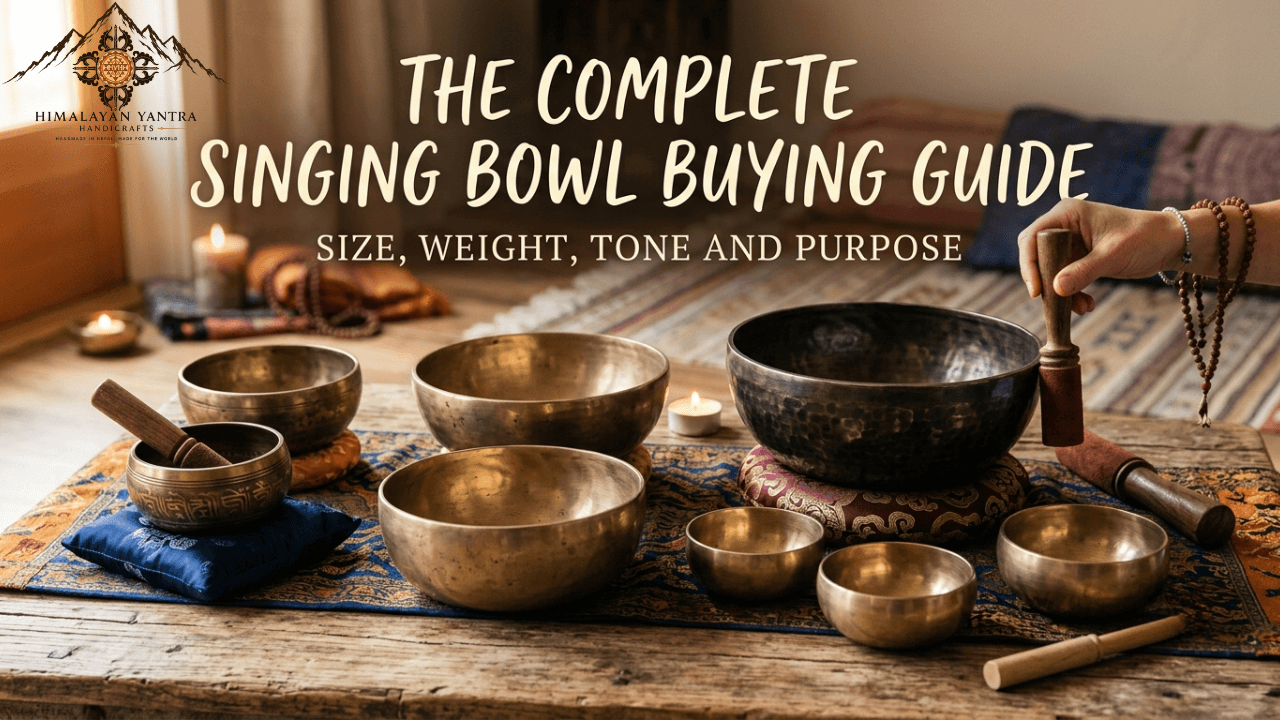
Namaste, the topic is important because handmade instruments are not completely interchangeable. The Complete Singing Bowl Buying Guide: Size, Weight, Tone, and Purpose should be seen as a practical, evidence-based question, not as a promise of one automatic answer. This 2026 guide combines product knowledge, online shopping standards, cultural responsibility, and the real concerns of customers who often cannot inspect an item in Nepal before making a purchase. Himalayan Yantra Handicraft, located in Thamel, Kathmandu, aims to connect handmade Nepalese instruments and spiritual crafts with meditators, yoga teachers, sound practitioners, collectors, studios, and responsible travellers worldwide. The article aims to clarify the singing Bowl Buying Guide - Size, weight, tone, and purpose—while avoiding exaggerated claims about medical, historical, or spiritual topics.
Why Your Singing Bowl Journey Must Begin with Purpose (Not Price) -Begin with the buyer’s real purpose.
The first step in understanding the Singing Bowl Buying Guide - Size, Weight, Tone, and Purpose, is to replace vague expectations with a specific use case. A traveling teacher, a home meditator, and a retreat center have different needs when it comes to size, accessories, and durability. A useful way to think about this is to note where the object will be played, who will handle it, and how often it will be moved. Dimensions are important, but they should be considered alongside weight, wall thickness, and the design of the base. At Himalayan Yantra Handicraft, recommendations start with purpose rather than price, decoration, or trends.
Ditch the Vague Labels: Why Exact Measurements Matter When Buying Online—The Reality of Singing Bowl Specifications.
When assessing the Singing Bowl Buying Online Guide—Size, Weight, Tone, and Purpose—distinguish what can be measured from what must be experienced. Diameter, height, weight, and visible condition can be documented directly. Tone, response, and personal preference require listening or demonstration. The practical lesson is clear: do not replace either category with exaggerated descriptions. Weight impacts handling, shipping, vibration, and comfort, so it should be listed in precise units instead of simply labeled as light or heavy.
Listen for character, not just volume.
A valuable evaluation of the Singing Bowl Buying Guide - Size, Weight, Tone, and Purpose—focuses on sensory character without making personal preferences a universal standard. One listener might enjoy a bright, focused tone, while another may prefer warmth and a slower decay. Therefore, buyers should compare several bowls at a similar volume and let the sound fade completely. A handmade bowl creates a layered sound field; a single tuner reading cannot capture the full range of fundamental tone, overtones, and decay.
The Best Way to Test a Singing Bowl's Sound and Vibration: Read the product evidence carefully.
Practical testing of a singing bowl should be simple and repeatable. Place the bowl on a stable cushion or in an open palm, use the recommended mallet, and start with light contact. Observe how quickly the sound emerges, whether the vibration remains steady, and how the bowl feels in your hand or the room. Change only one variable at a time, such as mallet type, striking point, or speed. While dimensions are useful, they must be considered alongside weight, wall thickness, and the design of the base.
Compare craftsmanship without romanticizing it.
A common mistake is to judge the Singing Bowl Buying Guide - Size, Weight, Tone, and Purpose—based on only one feature. Buyers might focus solely on note, age, shine, decoration, metal content, or price. For an online customer, a worthwhile instrument results from multiple qualities working together: construction, condition, response, sound, usability, and honest representation. Weight affects handling, shipping, vibration, and comfort, so it should be expressed in concrete units rather than described as just light or heavy.
How Much Do Singing Bowls Cost? Understanding Value and Craftsmanship
Craft and cultural context deserve careful consideration. Handmade items reflect labor, skill, and learned techniques, but the maker should not be reduced to a faceless symbol of tradition. In a professional setting, good content details the process, names contributors with permission, and avoids fabricating stories that make a product seem more exotic. A handmade bowl creates a layered sound field; one tuner reading cannot capture the combination of fundamental tone, overtones, and decay. Responsible sourcing also considers the continuity of skill, fair commercial relationships, and respect for the connected communities.
Use modern online shopping tools wisely.
Digital tools are valuable for reducing uncertainty. A zoomable photograph can show surface details; a scaled image clarifies size; an uncompressed audio sample supports comparisons; and a video demonstrates playing techniques. For online customers, none of these substitutes has honest written specifications. While dimensions are useful, they should be read alongside weight, wall thickness, and the design of the base.
The Buyer's Checklist: How to Get an Honest Singing Bowl Recommendation.
At Himalayan Yantra Handicraft, the Singing Bowl Buying Guide - Size, Weight, Tone, and Purpose—is seen as a chance to educate before selling. Customers should understand why one option may be a better fit for them, even if it isn’t the most expensive. Online staff recommendations should focus on purpose, sound, handling, and practical constraints. Weight affects handling, shipping, vibration, and comfort, so it should be listed in exact units rather than described only as light or heavy.
How Himalayan Yantra Selects Your Singing Bowl: Personalized Support vs. General Advice.
Before making a final decision about the singing Bowl Buying Guide - Size, weight, tone, and purpose—take a moment to verify the essentials: the exact product, size, sound, included accessories, condition, origin, price, packing method, and after-sales support. In a professional setting, save screenshots or product codes for one-of-a-kind items to avoid confusion about what will be shipped. A handmade bowl creates a layered sound field; one tuner reading cannot capture the full blend of fundamental tone, overtones, and decay. Himalayan Yantra Handicraft can then answer any remaining questions based on the specific item instead of providing only general advice.
The Singing Bowl Checklist: How to Choose a Long-Term Investment
Keep the long-term perspective in mind. A carefully chosen object should remain playable, understandable, and supported after the initial excitement of purchase. Retain the product information, record any unique identification number, and learn the basic care routine. In a professional setting, review your choice after several weeks of use to note which qualities have proven most valuable. While dimensions are useful, they should be considered alongside weight, wall thickness, and the design of the base. This experience can inform future purchases.
Conclusion. How to Choose Your Singing Bowl with Confidence
The Himalayan Yantra promises connecting you to real, authentic Nepalese artistry. Ultimately, the Singing Bowl Buying Guide - Size, Weight, Tone, and Purpose—should lead to a decision that is easy to explain. Customers should understand what the object is, why it fits their intended use, how its main qualities were evaluated, and what support is available after the purchase. Himalayan Yantra Handicraft aims to provide this clarity through detailed product information, authentic stories from Nepal, careful selection, and respectful education. When information and commerce are managed this way, the result is more than just a list on a search engine; it becomes a valuable connection between the maker, the instrument, the practice, and the owner.