

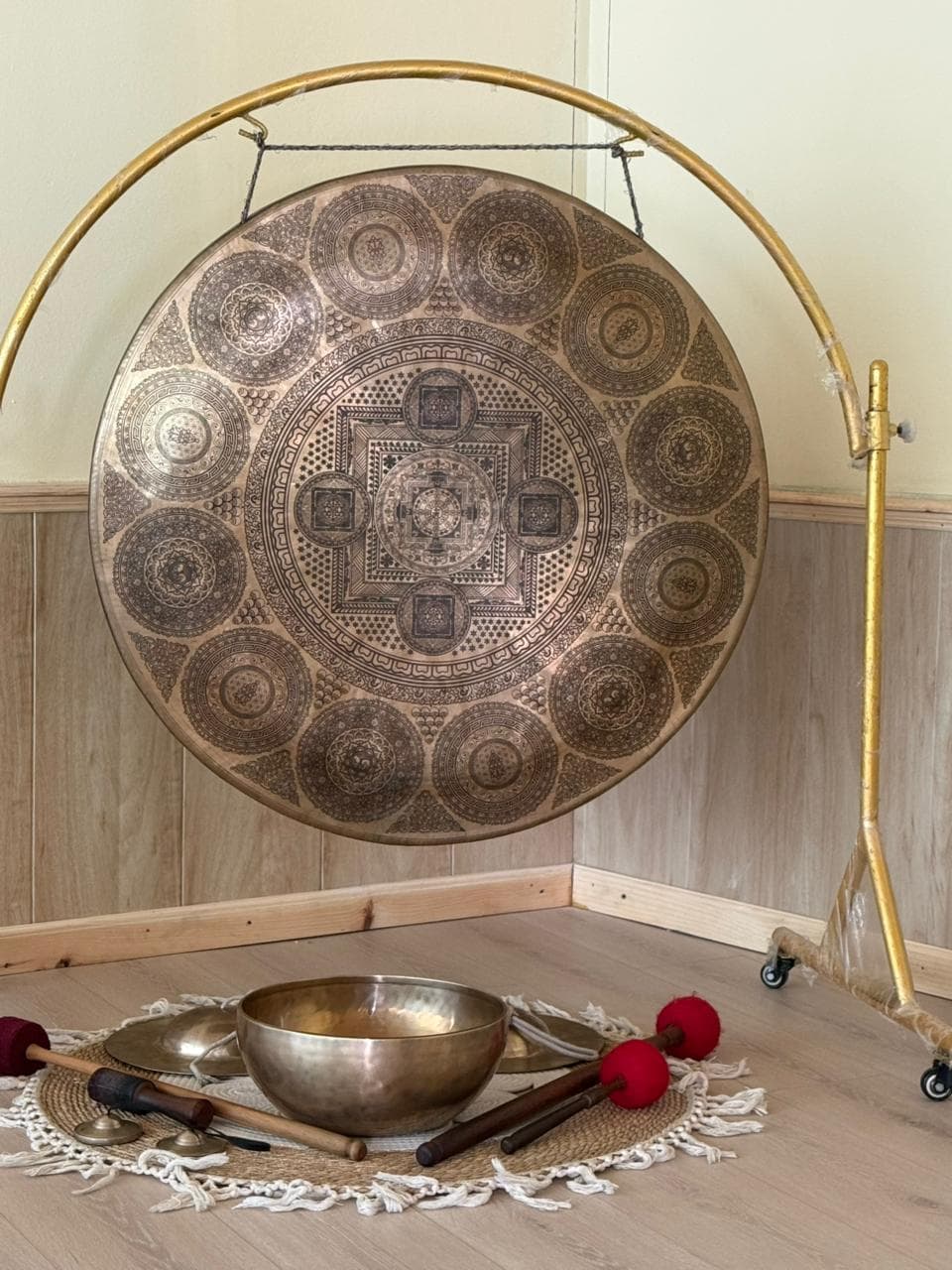
The Ultimate Guide to Sound Healing Gongs & Their Benefits
The soft, rhythmic thwack of heavy wooden mallets striking glowing bronze echoes through a narrow alleyway in Patan, just south of Kathmandu. The air carries the smell of sulfur, woodsmoke, and hot metal. Inside a dim workshop with a clay floor, four men stand in a semi-circle around a massive glowing disc of metal. Their movements align perfectly, creating a fluid dance of raw strength and ancient metalworking. They are forging a healing gong—an instrument meant not to play musical scales but to calm the human nervous system and encourage deep meditation.
For thousands of years, across the high plateaus of Tibet, the valleys of Nepal, and throughout Southeast Asia, the gong has been honored as an instrument of great spiritual power. It serves not just as a tool for making noise; it acts as a means of transformation. Today, as the modern world faces a rise in chronic stress, anxiety, and mental exhaustion, an ancient practice is finding new popularity: gong sound healing.
Commonly known as a gong bath, this form of sound gong therapy requires no effort from the participant. You don’t need to sit cross-legged until your knees hurt, nor do you have to try to "empty your mind" of thoughts. Instead, you simply lie down, close your eyes, and let the powerful acoustic vibrations wash over you.
This guide explores the rich history, complex science, significant health benefits, and detailed craftsmanship behind the sound healing gong. Whether you are an experienced meditation teacher, a curious seeker of wellness, or someone interested in buying an authentic, handmade instrument from Nepal, this guide will illuminate the path of sacred sound.
What is a Himalayan Gong? An Instrument of Infinite Resonance
To understand gong healing, you first need to move away from how Western music categorizes instruments. In classical music theory, instruments are divided based on what vibrates to create the sound—strings, air columns, or stretched skins. A gong belongs to a unique class of instruments called idiophones. This means that the entire body of the instrument vibrates when struck, turning the solid metal disc into a living source of acoustic energy.
Unlike a piano key or guitar string, which produces a focused musical note with predictable harmonics, a high-quality healing gong creates what acoustic physicists refer to as a "sound wash" or "tone cluster."
When a soft mallet hits the bronze face of a gong, the initial sound is a deep bass note. Within milliseconds, however, that sound fractures and multiplies. Waves of sound clash and blend within the metal, generating secondary tones, high-pitched overtones, and complex acoustic beats. The sound becomes a physical entity—a moving tapestry of frequencies that fills the room completely, making it impossible for the ear to pinpoint exactly where the sound comes from.
The Sacred History: From Ancient Signal to Monastic Medicine
The story of the Himalayan gong is closely linked to the history of metallurgy. While the specific origin of the gong is still debated among ethnomusicologists, early texts trace its development back to the Bronze Age, around 3,500 years ago, in areas that include modern-day China, Indonesia, Burma, and the Himalayan kingdoms.
The Metal of Heaven
In ancient Asian cultures, making a gong was viewed as a sacred ritual. The bronze alloy used, often called "the metal of heaven," was believed to have cosmic properties. Gong makers were not just laborers; they were seen as shamans and guardians who knew how to capture the voice of the universe in a metal sheet.
Raw Bronze Ingots ➔ Repeated Fire Heating ➔ Synchronized Hand-Hammering ➔ The Master's Tuning
Throughout its long history, the gong has served several important cultural functions:
The Voice of Authority: In ancient Chinese courts, gongs were struck to announce the arrival of emperors, high-ranking officials, and royal processions.
The Spiritual Cleanser: In Buddhist monasteries across Tibet and Nepal, large gongs were used to signal the start of silent meditation sessions, clear temple spaces of negative energy, and mark sacred transitions in rituals.
The Symbol of Wealth: In traditional Indonesian culture, owning a finely tuned gong conferred great prestige. Gongs were passed down as priceless heirlooms and even used as currency in royal dowries.
As these instruments traveled along ancient silk and salt trade routes through the Himalayas, the spiritual practitioners of Nepal and Tibet recognized that the gong's deep, sustained vibrations had a calming effect on the mind and body. It evolved from a ceremonial tool into an important source of energetic healing.
The Acoustic Anatomy: Types of Gongs Used in Healing
If you visit a genuine workshop or look for a healing gong, you'll find that gongs come in various shapes, edge designs, and tonal qualities. It benefits sound therapy and meditation; four main styles stand out.
The Chao Gong (The Grounding Force)
The Chao gong is perhaps the most recognizable design. It has a flat face with a heavy outer rim that turns upward at a right angle. The center and outer edge are often covered in black copper oxide from the forging process, while a middle ring is polished to reveal the golden bronze underneath.
Acoustic Profile: When struck gently, it produces a deep, grounding bass note. When hit with more force, the sound bursts into a rich wash of overtones.
Healing Use: Excellent for deep physical relaxation, root chakra work, and clearing stagnant energy in large meditation spaces.

The Wind Gong (The Mental Cleanser)
The wind gong (also known as a Feng gong) is a flat disc without a turned-up rim. Its entire surface is polished to a bright, shiny gold finish. Lacking a rigid rim to contain sound waves, the metal is highly flexible.
Acoustic Profile: It opens up with very little force. It produces a bright, fast sound that resembles a rushing wave of wind or water, focusing on high, shimmering frequencies with few deep bass notes.
Healing Use: Ideal for clearing mental chatter, breaking anxious thought loops, and uplifting emotions.

The Nipple / Bossed Gong (The Focused Tuner)
Common in Southeast Asia and Indonesia, the nipple gong features a distinct raised dome in its center.
Acoustic Profile: Unlike the Chao or Wind gongs, which create overlapping sounds, a nipple gong produces a singular, focused pitch with minimal distortion, sounding much like a resonant bell.
Healing Use: Excellent for targeted sound therapy benefits, where a specific frequency is needed to align a particular chakra.

Planetary Gongs (The Cosmic Resonators)
Planetary gongs are a modern development of classic German and Himalayan gong-making practices. These gongs have flat profiles or slight rims but are tuned with precise science to match the orbital frequencies of celestial bodies, as calculated by Swiss mathematician Hans Cousto.
Acoustic Profile: They produce pure, sustained harmonic overtones that pulse at specific intervals.
Healing Use: Used by advanced sound therapists for deep emotional and psychological alignment.

How Gong Healing Works: The Experience of a Sound Bath
To understand why a gong bath is so effective, you need to know what happens during a typical session.
The experience begins before any sound is made. Participants enter a quiet, dimly lit room and lie down on comfortable yoga mats. They receive pillows for knee support, blankets for warmth (as body temperature drops during deep relaxation), and sometimes eye masks to block out visual distractions. A TYPICAL 60-MINUTE GONG BATH
- 10 Min: Settle down, slow breathing, set mental intentions.
- 10-25 Min: Soft, rhythmic strikes; heart rate begins to drop.
- 25-50 Min: The Sound Wash peak; full brainwave synchronization.
- 50-55 Min: The "Shunyata" (Sacred Silence); profound inner peace.
- 55-60 Min: Gentle grounding bells and awakening stretching.
When the practitioner strikes the gong for the first time, the sound is barely audible, like a gentle, distant hum that resembles the soothing sound of the ocean. Slowly, layer by layer, the volume and complexity of the sound increase.
As the sound waves grow stronger, participants describe a strange and beautiful sensation. They struggle to determine where their physical body ends and where the sound begins. The intense, multi-layered sound completely overwhelms the brain's rational processing. Unable to categorize, analyze, or worry about the complex mix of frequencies, the logical mind simply surrenders. The listener enters a waking dream state, a sanctuary of profound stillness where deep cellular healing occurs.
The Science of Vibrational Medicine: Brainwaves and Biological Syncing
To those unfamiliar with it, the idea of sound healing using a gong might seem purely mystical. However, the principles of sound gong therapy are closely linked to the laws of organic physics and neuroscience.
The Principle of Entrainment
At the core of sound healing is a basic law of physics known as entrainment. Discovered in 1665 by Dutch physicist Christian Huygens, entrainment occurs when two interacting oscillating systems-things that vibrate or pulse at different rhythms—become synchronized. The stronger, more stable frequency always causes the weaker, chaotic frequency to align with its rhythm.
The human brain generates electric impulses that pulse at various speeds depending on our state of consciousness. When we are stressed, anxious, working, or overthinking, our brains operate in the beta wave state (12 to 30 Hz). Beta waves are fast, erratic, and crucial for daily survival, but staying in them for prolonged periods exhausts our bodies, floods our blood with cortisol, and weakens our immune system.
When you lie down in a gong bath, your chaotic, stressed brainwaves are met with the powerful and well-structured acoustic vibrations of the bronze disc. Through the process of entrainment, your fast beta brainwaves begin to slow, matching the deeper frequencies of the instrument.
Within ten to fifteen minutes, your brain shifts from beta to the alpha wave state (8 to 12 Hz), characterized by relaxed, calm, and creative daydreaming. As the session continues, the brain dives even deeper into the Theta wave state (4 to 8 Hz).
The Theta Healing Zone: Theta is the state of consciousness reached by master monks after years of rigorous meditation. It exists in the twilight between waking and sleeping. In the Theta state, the body's self-healing mechanisms activate, cellular regeneration speeds up, and the subconscious mind becomes accessible, allowing the gentle release of deeply rooted trauma.
In incredibly profound sessions, brain activity can even briefly dip into delta waves (0.5 to 4 Hz), a state of dreamless, restorative sleep where growth hormones are released and deep tissue repair occurs.
The Benefits of Gong Therapy
Since sound vibrations penetrate every cell in our bodies, the therapeutic benefits of regular gong meditation encompass our physical, emotional, and spiritual well-being. Here is a detailed list of 15 scientifically and historically observed benefits of this ancient practice.
Physical Healing Benefits
Direct Reduction of Chronic Pain
The acoustic waves from a large gong act like an internal cellular massage. These deep vibrations improve blood flow, ease chronic muscle spasms, and block pain signals in the nervous system, providing natural relief for people suffering from fibromyalgia, arthritis, and chronic back pain.
Regulation of Blood Pressure and Heart Rate
As your brainwaves slow down due to sound entrainment, your autonomic nervous system shifts from the sympathetic branch ("fight or flight") to the parasympathetic branch ("rest and digest"). This change immediately dilates blood vessels, lowers your heart rate, and reduces systemic blood pressure.
Eradication of Insomnia and Sleep Disorders
By training the brain to transition smoothly from high-frequency beta states into deep theta and delta states, regular gong therapy resets the body's natural circadian rhythms, helping chronic insomniacs fall asleep faster and achieve deeper REM cycles.
Boosted Immune System Function
Chronic stress releases high levels of cortisol, which suppresses the body's white blood cells. By helping the body reach a state of complete relaxation, gong baths halt cortisol production, allowing the immune system to regain its natural defenses against viruses and bacteria.
Release of Deep Muscular and Fascial Tension
Our connective tissues (fascia) store physical tension from sedentary lifestyles and poor posture. The strong physical resonance of a gong vibrates through the fascia, shaking loose microscopic tension and restoring natural elasticity to the muscles.
Mental and Emotional Benefits
Quick Reduction of Severe Anxiety and Panic
For someone caught in an anxiety cycle, traditional silent meditation can feel impossible. The loud, enveloping sound of a gong serves as an anchor for the mind, instantly cutting off racing thoughts and calming the overactive amygdala (the brain's fear center).
Somatic Release of Trapped Emotional Trauma
Psychological studies indicate that traumatic memories are often stored physically in our bodies and tissues. The deep, penetrating tones of a gong can trigger the safe release of locked emotions, allowing participants to process and let go of years of repressed grief, anger, or fear without needing to articulate it.
Elimination of Mental Fog and Fatigue
Living in a constant state of digital distraction can leave our minds feeling drained and fractured. A 60-minute sound wash acts like a hard reboot for cognitive systems, sweeping away fatigue and resulting in clearer thinking and sharper focus.
Natural Stimulation of Neurotransmitters
The harmonics from a well-crafted gong stimulate the vagus nerve, prompting the brain to release beneficial neurochemicals, including endorphins (natural pain relievers), serotonin (mood stabilizers), and dopamine (pleasure signals).
Breaking of Addictive Thought Patterns
By helping the brain access the restorative Theta state, gong therapy allows individuals to step back from compulsive behaviors, creating the calm mental space needed to break free from repetitive cravings and substance-dependent cycles.
Spiritual Growth Benefits
Realignment of the Chakra System
In traditional Eastern medicine, the human body is believed to have seven primary energy centers called chakras, each vibrating at a specific subtle frequency. The wide tonal range of a Himalayan gong ensures that every chakra receives its matching harmonic frequency, dissolving energetic blocks and restoring balanced flow.
Easier Access to Deep Meditation
For many people today, sitting in silence for an hour can be frustrating. The gong simplifies meditation; its rich sound bypasses the restless "monkey mind," helping beginners achieve deep meditative states that normally take years to reach through silent discipline.
Awakening of Higher Intuition
As the rational, analytical left brain steps aside during a sound journey, the creative, intuitive right brain takes over. Many practitioners report sudden insights, creative solutions to complex problems, and a deeper connection to their inner voice.
Access to Vivid Astral and Dream States
During a gong bath, it’s common to experience beautiful internal journeys—seeing swirling colors, recalling memories from childhood, or feeling weightless as if floating outside of your body.
Realization of Universal Oneness and Grounding
Emerging from a sound bath, participants often experience a deep peace known in Sanskrit as Shanti. This feeling of being grounded, safely anchored to the earth, and beautifully intertwined with the universe is profound.
The Practitioner’s Art: How to Play a Gong for Healing
Playing a gong for entertainment or orchestral purposes is very different from playing it to guide people through a deep emotional healing experience. A true sound therapist treats the instrument with respect, focus, and skill.
THE ANATOMY OF A STRIKE FOR GONG
Outer Rim Area
- Produces high, bright overtones.
- Best for mental clarity and focus.
Inner Area
- Produces deep, heavy bass.
- Best for deep physical relaxation.
The Main Principles & Benefit of Sound Therapy:
Never Strike the Absolute Center: Unless you are specifically playing a bossed/nipple gong, hitting a flat gong directly in its center produces a harsh sound that can startle an anxious person out of their meditative state. Instead, practitioners strike the gong in a "sweet spot" about two to three inches from the center.
Vary the striking zones: A skilled player treats the gong like a map. Striking near the outer rim creates high-pitched, ethereal overtones, while striking closer to the center reveals deep, thunderous bass notes. By moving the mallet gently around the gong in a circular motion, the player weaves a complex mix of low and high frequencies.
The Importance of Mallet Selection: The mallet serves as the bridge between the player and the metal. Hard mallets create sharp, sudden attacks that work well for orchestral music but are not suitable for therapy. Sound healers use large, soft mallets that create warm, gentle vibrations.
The Home Practice: A Beginner's Guide to Gong Meditation
You do not need to be a certified sound therapist to bring the healing frequencies of a gong into your daily life. Owning a smaller or medium-sized gong at home can completely revolutionize your morning or evening mindfulness routine. Here is a simple, highly effective framework for practicing home gong meditation.
Step 1: Create Your Sonic Sanctuary
Find a quiet room in your home where you will not be disturbed by phone alerts or family members. Hang your gong on a sturdy metal or wooden stand. Place a yoga mat, blanket, and cushion on the floor. Position your mat so that your feet point toward the gong, keeping a distance of at least three to five feet to ensure the physical sound waves have enough room to properly unfurl before hitting your body.
Step 2: Clarify your intentions
Sit quietly before your instrument for sixty seconds. Close your eyes and anchor your awareness to your breathing. Hold your mallet in your dominant hand, and formulate a silent intention for your practice. Your intention could be incredibly simple: "I intend to release my daily worries," or "I invite deep physical rest into my body."
Step 3: Gentle Awakened Striking
Open your eyes and strike the gong very gently once. Listen with full attention as that single note slowly blooms, peaks, and begins to fade. Just before the sound disappears completely, strike it again, slightly changing the location of your stroke. Slowly build a soft, continuous wave of sound. Keep your wrist completely relaxed, allowing the natural weight of the mallet to do the work. Continue this gentle, steady playing for ten to fifteen minutes.
Step 4: Rest in the Sublime Silence
Slowly reduce the strength of your strikes until you let the instrument fade into complete silence. Drop your mallet, lay your body flat down on your mat, and wrap yourself in your blanket. Spend five minutes resting in the absolute stillness that follows. In the yoga tradition, this deep silence is called Shunyata—the void. It is in this post-sound silence that your brain fully integrates the healing benefits of the frequencies.
The Buyer's Roadmap: How to Choose Your Healing Gong
Purchasing a sound healing gong is a highly personal, intuitive investment. Because a high-quality bronze gong will easily last for several generations, it is vital to pick an instrument that aligns with your specific goals, lifestyle, and environment.
The Dimension Guide: Choosing Your Size
The physical diameter of a gong dictates its weight, portability, and the depth of its acoustic range.
| Gong Size (Diameter) | Portability | Primary Sonic Qualities | Best Use Cases |
| 30 to 40 cm | Exceptionally high; easily fits into a backpack. | High, clear, sweet tones; rapid decay with minimal bass footprint. | Perfect for personal travel, opening/closing yoga classes, or office space clearing. |
| 50 to 60cm | Moderate; can be carried in a padded shoulder bag. | The classic sweet spot. Deep, resonant bass mixed with brilliant overtones. | The ideal choice for home meditators, therapists, and mobile sound healers. |
| 70 cm and Above | Low; requires a permanent stand and a dedicated vehicle to move. | Massive, thunderous, and sweeping bass notes; immense physical vibration. | Best for large professional sound healing centers, ashrams, and large group sessions. |
As you search for a healing gong for sale, you will encounter two vastly different manufacturing methods:
Machine-Stamped Gongs: These are made in large factories from inexpensive brass or sheet metal. They appear flawless, smooth, and polished. However, because the metal density is uniform and lacks structure, they create flat, metallic sounds that fade quickly. They do not have the layered overtones needed for real therapy.
Hand-Hammered Gongs: These gongs are made by hand from high-quality bronze alloys, typically 80% copper and 20% tin. Their surfaces have thousands of tiny hammer marks. These small variations create an uneven density across the metal face. When struck, these differences cause the sound waves to bend, twist, and collide, producing the rich, therapeutic overtones that make sound healing effective.

The Craftsmanship of Kathmandu: Why Authenticity Matters
If you want true vibrational authenticity, you should look to the Kathmandu Valley of Nepal.
The Heritage of Himalayan Metalwork
For over a thousand years, the Newar artisans of Kathmandu and Patan have been known as some of the best metal craftsmen in Asia. Their expertise in metallurgy is a closely guarded family secret, passed down orally from father to son through many generations.
When you buy an authentic Himalayan gong from a dedicated group like Himalayan Yantra, you are not just getting an instrument; you are keeping a piece of living human heritage.
THE ALLOY is premium healing bronze with 80% pure copper and 20% pure tin. The artisans of Kathmandu create gongs using a special, labor-intensive hot-hammering method. They melt raw bronze ingots in small clay furnaces and pour them into circular flat cakes. These hot metal discs are then removed from the fire, held with iron tongs, and struck simultaneously by three or four master smiths swinging heavy hammers in perfect sync.
This process of heating, hammering, cooling, and reheating is done many times. As the metal thins and expands, the master smith tunes the instrument by carefully listening to the subtle changes in tone after each hammer strike. In many traditional workshops, artisans chant sacred mantras and infuse deep intentions of peace and healing into the glowing bronze with each hit of the hammer.
A handmade gong from Kathmandu holds spiritual weight, visual beauty, and a complex, warm sound that factory-made instruments simply cannot match.
Frequently Asked Questions (FAQs)
What is the difference between a gong bath and a singing bowl session?
While both use sound therapy, singing bowls produce highly focused, soothing, and melodic tones that circulate in a room. A large gong produces a massive, wrapping, and unpredictable wash of sound that vibrates much more intensely through the physical tissues of the body. They complement each other beautifully.
Can a gong bath cause damage to my ears?
A professional sound healer will never play a gong at a dangerous volume. While the sound feels massive and filling, the frequencies are deep, soft, and completely safe for your hearing. If you have hyper-sensitive hearing, you can simply sit further away from the instrument.
Why do some people cry or laugh during a gong therapy session?
The intense physical frequencies of a gong act like an emotional key, unlocking stored tension within your nervous system. It is incredibly common and healthy for participants to experience a spontaneous release of tears, laughter, or profound joy as old emotional blocks dissolve.
Do I need to hold any specific religious beliefs to benefit from gong healing?
No. Gong therapy is completely secular and non-dogmatic. It relies entirely on the natural laws of acoustic physics and neuroscience. Anyone, regardless of their cultural or spiritual background, can benefit from the science of sound entrainment.
Is it safe for individuals with pacemakers to attend a gong bath?
Because large gongs produce powerful, palpable physical vibrations that travel through space, individuals with pacemakers or coronary stents should sit a safe distance away (at least 15-20 feet) from the instrument or consult their doctor before attending.
What is the white powdery film that sometimes forms on handmade gongs?
This is a natural copper oxide film that forms as the bronze alloy reacts to moisture and oxygen in the air. It does not damage the instrument and can be wiped away gently with a soft, dry cloth.
How should I clean my sound healing gong?
Never use harsh chemical metal polishes or abrasive scrubbers, as these can alter the microscopic hammer marks and permanently ruin the instrument’s tuning. Simply wipe the surface down once a week using a clean, dry microfiber cloth.
Can I play a gong without a stand?
Small gongs (under 14 inches) can be held comfortably by their suspension cords. However, medium and large gongs are far too heavy to hold and must be hung from a sturdy metal or wooden stand to allow the metal to vibrate freely.
Why does my body feel cold during a sound bath?
As your nervous system shifts into a deep parasympathetic state, your heart rate, metabolism, and blood pressure naturally drop, which cools your internal body temperature. This is why professional sound healers always provide thick blankets for participants
How can I tell if a gong for sale online is truly handmade?
Look closely at the surface photos. A genuine handmade gong will feature thousands of small, slightly irregular, overlapping concentric hammer indentations. A machine-stamped gong will look perfectly flat, smooth, and mirror-like.
Conclusion: The Return to Sound
In our modern, high-speed world, we are constantly bombarded by chaotic, unnatural frequencies—the roar of city traffic, the buzz of electronics, and the endless stream of digital notifications. This constant digital noise keeps our minds trapped in a state of low-grade, exhausting survival mode.
The ancient sound healing gong offers an elegant, time-tested antidote to the chaos of modern life. By stepping into a gong bath, we surrender our stress to the pure laws of physics, allowing sacred bronze frequencies to massage our cells, slow our frantic brainwaves, and guide us back into a natural state of inner harmony.
Whether you are looking to experience your very first group sound bath, bring a personal meditation gong into your home sanctuary, or acquire a master-crafted instrument for your professional healing practice, turning toward the power of sacred sound is a beautiful step toward holistic well-being.
Bring the Healing Echoes of the Himalayas Into Your Space
Himalayan Yantra, we work hand-in-hand with the finest generational metal artisans in Kathmandu, Nepal, to bring you authentic, premium, hand-hammered sound healing gongs. Each piece is an individual spiritual masterpiece, crafted with deep devotion and tuned to perfection.
Explore our curated collection of master-crafted gongs and start your personal sound healing journey today.