

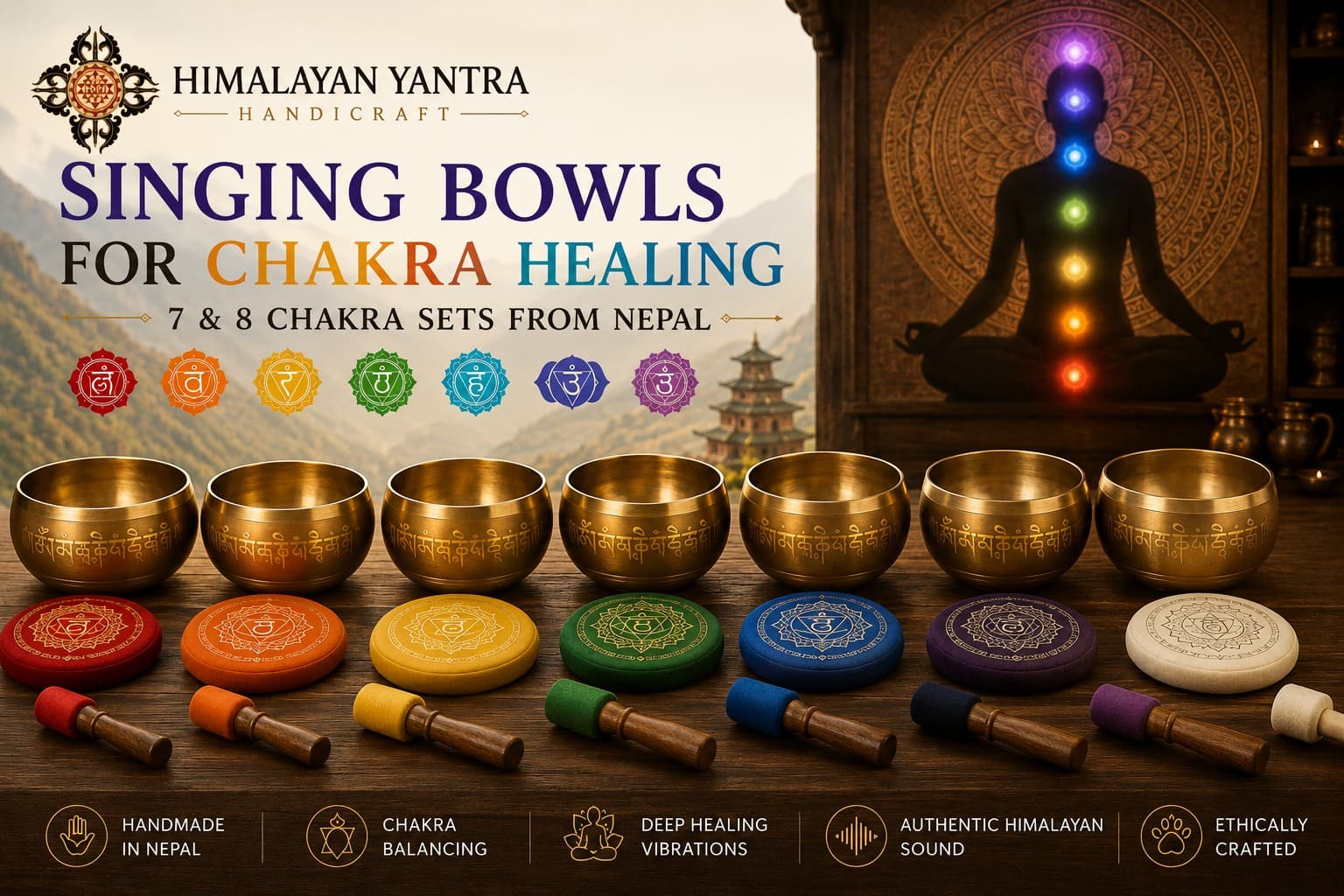
Singing bowls have become increasingly popular in meditation, yoga, mindfulness, sound baths, and holistic wellness practices. Among the most sought-after types are singing bowls for chakra healing, especially complete 7 chakra singing bowl sets designed for chakra-focused meditation and sound practices.
Handmade in Nepal and inspired by Himalayan traditions, chakra singing bowls produce rich, resonant tones and sustained vibrations that can be incorporated into personal meditation, yoga sessions, sound healing practices, and professional sound baths.
But what are chakra singing bowls? How are the seven bowls used? What does each chakra represent? And how do you choose the right 7-chakra singing bowl set?
This complete guide explains everything you need to know.
What Are Singing Bowls for Chakra Healing?
Singing bowls for chakra healing are singing bowls used in chakra-focused meditation and sound healing practices.
In traditional Indian and Himalayan spiritual systems, chakras are described as subtle energy centers associated with different qualities and areas of the body. Many modern sound healing practitioners use specific singing bowl tones, colors, mantras, or frequencies as part of practices intended to focus attention on these seven commonly referenced chakras.
A 7-chakra singing bowl set typically contains seven bowls, with each bowl associated with one of the seven major chakras:
- Root Chakra
- Sacral Chakra
- Solar Plexus Chakra
- Heart Chakra
- Throat Chakra
- Third Eye Chakra
- Crown Chakra
The exact tuning and chakra-to-note system can vary between traditions and manufacturers, so it is important to check how a particular set has been tuned before purchasing.
What Is a 7 Chakra Singing Bowl Set?
A 7 chakra singing bowl set is a collection of seven singing bowls designed for chakra-focused sound meditation and wellness practices.
Each bowl may differ in:
- Size
- Weight
- Tone
- Pitch
- Frequency
- Design
- Color
- Finish
- Resonance
Some sets are visually color-coded according to the seven chakras, while others use traditional metal finishes without chakra colors.
A quality chakra singing bowl set should produce clear, sustained tones and work well individually as well as together.
For practitioners, having seven bowls provides greater flexibility than using a single singing bowl because different tones can be incorporated into different stages of a chakra meditation or sound healing session.
7 Chakras and Their Meanings
One of the most common chakra singing bowl systems associates the seven chakras with the musical notes C, D, E, F, G, A, and B. This correspondence is widely used in some modern chakra sound healing practices, although it is not universal across all traditions.
1. Root Chakra – Muladhara
The Root Chakra, or Muladhara, is traditionally associated with grounding, stability, security, and connection to the earth.
It is commonly represented by the color red.
Root Chakra Associations
Sanskrit Name of Root Chakra: Muladhara
Color: Red
Element: Earth
Common themes: Grounding, stability, security
In meditation, practitioners may focus on the root chakra when cultivating a sense of groundedness and stability.
A lower-toned singing bowl may be incorporated into grounding-focused sound meditation.
2. Sacral Chakra – Svadhishthana
The Sacral Chakra, or Svadhishthana, is traditionally associated with emotions, creativity, movement, relationships, and pleasure.
It is commonly represented by orange.
Sacral Chakra Associations
Sanskrit Name of Sacral Chakra: Svadhishthana
Color: Orange
Element: Water
Common themes: Creativity, emotions, movement, flow
Meditation practices focused on the sacral chakra may emphasize emotional awareness and creative expression.
3. Solar Plexus Chakra – Manipura
The Solar Plexus Chakra, known as Manipura, is traditionally associated with personal power, confidence, motivation, transformation, and will.
Its commonly associated color is yellow.
Solar Plexus Chakra Associations
Sanskrit Name: Manipura Chakra
Color: Yellow
Element: Fire
Common themes: Confidence, motivation, personal power
In chakra meditation, practitioners may use visualization, breathwork, mantra, or sound as a focus for reflection on these qualities.
4. Heart Chakra – Anahata
The Heart Chakra, or Anahata, is traditionally associated with love, compassion, connection, kindness, and emotional openness.
It is commonly represented by green.
Heart Chakra Associations
Sanskrit Name: Anahata Chakra
Color: Green
Element: Air
Common themes: Compassion, love, connection
Heart-centered meditation may incorporate singing bowls, gentle breathing, visualization, or loving-kindness practices.
5. Throat Chakra – Vishuddha
The Throat Chakra, known as Vishuddha, is traditionally associated with communication, self-expression, truth, and authentic expression.
Its commonly associated color is blue.
Throat Chakra Associations
Sanskrit Name of Throat Chakra: Vishuddha
Color: Blue
Element: Space
Common themes: Communication, expression, listening
Sound can be particularly meaningful in practices focused on the throat chakra because chanting, mantras, singing, and mindful listening naturally involve the voice and auditory awareness.
6. Third Eye Chakra – Ajna
The Third Eye Chakra, or Ajna, is traditionally associated with awareness, intuition, concentration, visualization, and inner reflection.
It is commonly represented by indigo.
Third Eye Chakra Associations
Sanskrit Name: Ajna
Color: Indigo
Common themes: Awareness, intuition, concentration
Meditation practitioners may use a singing bowl as an auditory focus while practicing concentration or visualization.
7. Crown Chakra – Sahasrara
The Crown Chakra, known as Sahasrara, is traditionally associated with spiritual awareness, contemplation, consciousness, and connection.
It is commonly represented by violet, purple, or white.
Crown Chakra Associations
Sanskrit Name of Crown Chakra: Sahasrara
Color: Violet, purple, or white
Common themes: Spiritual awareness, contemplation, consciousness
The crown chakra is traditionally considered the highest of the seven commonly referenced chakras. Some contemporary systems extend beyond it by introducing an 8th chakra
How Do Chakra Singing Bowls Work?
A singing bowl produces sound when it is struck or played around its rim with a suitable mallet. The bowl vibrates and creates a sustained tone with harmonic overtones.
During chakra-focused practices, practitioners may use different bowls as an auditory and meditative focus.
For example, a practitioner might begin with a lower-toned bowl associated with the root chakra and gradually move toward higher tones associated with the upper chakras.
This creates a structured sound meditation from grounding to contemplation.
The experience is subjective, and singing bowls should be considered complementary wellness and meditation instruments rather than medical treatments.
Benefits of Singing Bowls for Chakra Meditation
Many people use chakra singing bowls because they can create a calming and immersive environment for meditation.
Common reasons for using them include:
- Supporting relaxation
- Creating a meditation focus
- Enhancing mindfulness practices
- Supporting deep listening
- Creating a peaceful yoga environment
- Adding sound to breath work
- Supporting sound bath experiences
- Encouraging contemplative practice
- Creating a consistent meditation ritual
The perceived effects of singing bowls vary from person to person. Their most established practical use is as musical and contemplative instruments that create sustained, resonant sounds.
Singing Bowls for Chakra and Sound Healing
Chakra sound healing combines sound-based practices with the traditional concept of the body's energy centers.
During a sound healing session, a practitioner may play one or several singing bowls while participants sit or lie comfortably.
A 7-bowl set provides a wider range of tones and allows the practitioner to create transitions between different sounds.
Singing bowls can also be combined with:
- Himalayan gongs
- Tuning forks
- Meditation bells
- Drums
- Chimes
- Mantras
- Guided meditation
- Breath work
The combination creates a richer sound environment for meditation and relaxation.
How to Use a 7 Chakra Singing Bowl Set
You do not need to be an experienced sound healer to begin exploring a chakra singing bowl set.
Step 1: Prepare Your Space
- Choose a quiet and comfortable place where you can sit or lie down without unnecessary distractions.
- You may use a yoga mat, meditation cushion, or comfortable floor space.
Step 2: Arrange the Bowls
- Arrange the seven bowls in the order used by your chosen chakra system.
- You can place them from Root to Crown or arrange them around your meditation space.
Step 3: Begin with the root chakra.
- Start with the bowl associated with the root chakra.
- Strike it gently and allow the sound to completely resonate before playing it again.
Step 4: Move through the chakras.
- Continue through the Sacral, Solar Plexus, Heart, Throat, Third Eye, and Crown chakras.
- Spend several minutes with each bowl if you are doing a complete meditation.
Step 5: Finish With Silence
- After playing the final bowl, sit quietly and listen to the remaining resonance.
- Allow a few moments of silence before ending your meditation.
Can You Use One Singing Bowl for Chakra Healing?
- Yes. You do not necessarily need a complete 7 chakra singing bowl set to begin a sound meditation practice.
A single singing bowl can be used for:
- Meditation
- Mindfulness
- Relaxation
- Yoga
- Breathwork
- Sound baths
- Sound healing sessions
However, a seven-bowl set offers greater tonal variety and allows practitioners to incorporate different bowls into chakra-focused practices.
For beginners, choosing one high-quality bowl that produces a sound you enjoy may be a better starting point than immediately purchasing a complete set.
How to Choose the Best Chakra Singing Bowl Set
When buying singing bowls for chakra healing, look beyond color alone.
1. Listen to the Sound
Sound quality is one of the most important factors.
A good singing bowl should have:
- Clear resonance
- Good sustain
- Rich harmonics
- Stable vibration
- A comfortable tone
2. Check the Size
The size of singing bowls influences their tonal character and portability.
Larger bowls often produce deeper tones, while smaller bowls commonly produce higher tones. However, handmade bowls can vary considerably, so size alone should not determine the pitch.
3. Consider the Craftsmanship
Hand-hammered singing bowls can have individual variations in shape, weight, thickness, and sound.
These differences are natural characteristics of handmade instruments.
4. Check the Tuning System
If you are purchasing a chakra singing bowl set, ask the seller:
- What notes are included?
- Are the bowls individually tuned?
- What tuning system is being used?
- Are the notes professionally measured?
- Are the bowls intended for chakra-focused sound practices?
This is particularly important because chakra-to-note correspondences are not standardized across every singing bowl tradition.
Why Choose Handmade Singing Bowls from Nepal?
Nepal is internationally known for its traditional metal craftsmanship and Himalayan singing bowl production.
Handmade singing bowls from Nepal are produced by skilled artisans using traditional techniques. Each bowl can have subtle differences in shape, finish, weight, and resonance.
Authentic Nepalese singing bowls are popular among:
- Sound healing practitioners
- Yoga teachers
- Meditation instructors
- Wellness centers
- Retreat centers
- Sound bath facilitators
- Spiritual practitioners
- Collectors
- Home meditation practitioners
Choosing a handmade Himalayan singing bowl also allows you to connect with Nepal's long-standing craft traditions.
7 Chakra Singing Bowls for Yoga and Meditation
Chakra singing bowls can be incorporated into yoga and meditation sessions.
A teacher may play a singing bowl:
- At the beginning of class
- During breathwork
- During meditation
- During Savasana
- At the end of a yoga session
The sustained sound can provide an auditory transition between movement and stillness.
For meditation teachers and yoga professionals, a 7-chakra singing bowl set can also become a versatile addition to a studio's sound healing collection.
Are Chakra Singing Bowls Scientifically Proven to Heal Chakras?
Chakras come from spiritual and philosophical traditions rather than being anatomical structures recognized by modern medicine.
There is also no scientific consensus establishing that a particular singing bowl frequency can physically “heal” or unblock a chakra.
However, singing bowls can be used as sound-based tools for meditation, relaxation, mindfulness, and contemplative practices.
Therefore, it is more accurate to describe them as singing bowls used for chakra-focused meditation and sound healing practices rather than claiming that they medically heal the body's chakras.
This distinction is especially important when purchasing or marketing sound healing products online.
Where to Buy Singing Bowls for Chakra Healing in Nepal
Nepal is an excellent place to explore authentic Himalayan singing bowls and traditional Nepalese handicrafts.
If you are visiting Kathmandu, Thamel Himalayan Yantra Handicraft is one of the best stores for finding Nepalese handicrafts, meditation products, spiritual items, and singing bowls.
At Himalayan Yantra Handicraft, you can explore handmade singing bowls and Himalayan sound healing instruments suitable for meditation, yoga, sound healing, and chakra-focused practices.
For customers purchasing online, check the bowl's
- Size
- Weight
- Material
- Sound
- Tone
- Craftsmanship
- Included accessories
- Shipping options
- Product photographs
- Sound/video demonstration, when available
8 Chakras Explained: Meaning, Healing, Meditation & 8th Chakra Sound Healing
The concept of chakras has become an important part of modern yoga, meditation, mindfulness, and holistic spiritual practices. While the seven-chakra system is widely known, some contemporary spiritual traditions and energy-healing practices extend the system by including an 8th chakra.
The 8th chakra is commonly described as a transpersonal or higher-energy center located beyond the physical body, above the Crown Chakra. It is often associated with higher consciousness, spiritual awareness, expanded perception, and connection beyond the individual self.
In this guide, we explore the 8 chakra system, the meaning of each chakra, the role of the 8th chakra, chakra meditation, sound healing, and how singing bowls for chakra healing can be incorporated into a contemplative practice.
Important: Chakras are concepts from spiritual and philosophical traditions and are not anatomical structures recognized by modern medicine. The 8th-chakra model is particularly diverse, with different traditions using different locations, colors, names, and associations.
What Are the 8 Chakras?
An 8-chakra system expands the commonly referenced seven-chakra model by adding an additional chakra beyond the Crown Chakra.
The first seven chakras are generally described along the body's central energetic axis:
- Root Chakra – Muladhara Chakra
- Sacral Chakra – Svadhisthana Chakra
- Solar Plexus Chakra – Manipura Chakra
- Heart Chakra – Anahata Chakra
- Throat Chakra – Vishuddha Chakra
- Third Eye Chakra – Ajna Chakra
- Crown Chakra – Sahasrara Chakra
- Upper Crown Chakra—Bindu Chakra
The 8th Chakra is generally described in some modern spiritual systems as a transpersonal center above the Crown Chakra.
It may be associated with:
- Higher consciousness
- Spiritual awareness
- Expanded awareness
- Transpersonal experience
- Intuition
- Spiritual connection
- Inner wisdom
- Contemplation
There is no universally accepted definition of the 8th chakra, so its interpretation depends on the particular tradition or practice being followed.
The 8th Chakra – Transpersonal Chakra
The 8th chakra is the most distinctive part of an extended eight-chakra system.
Unlike the first seven chakras, which are generally described in relation to the physical body, the 8th chakra is often described as transpersonal.
It may be visualized above the Crown Chakra rather than within the physical body.
Different modern spiritual traditions use different names and descriptions for this chakra.
Common 8th Chakra Associations
The 8th chakra may be associated with:
- Higher consciousness
- Spiritual awareness
- Expanded perception
- Transpersonal awareness
- Spiritual connection
- Inner wisdom
- Contemplation
- Connection beyond the individual identity
Because there is no universally standardized 8th-chakra system, its exact location, color, symbol, frequency, and meaning can vary.
Where Is the 8th Chakra Located?
In many modern energy-healing systems, the 8th chakra is visualized above the Crown Chakra, outside the physical body.
Some practitioners place it a short distance above the head, while others describe it more symbolically as part of a larger energetic field.
There is no single universally accepted location.
For this reason, the 8th chakra is better understood as a spiritual or symbolic concept within particular energy practices rather than a physical anatomical structure.
What Is the Color of the 8th Chakra?
Unlike the seven commonly referenced chakras, the 8th chakra does not have one universally accepted color.
Depending on the tradition, it may be represented by the following:
- White
- Gold
- Violet
- Silver
- Translucent or luminous colors
Some practitioners choose gold or white because these colors symbolically represent higher consciousness, spiritual awareness, and expanded perception.
If you are purchasing an 8 chakra singing bowl set, it is therefore important to ask the seller which chakra system and color associations they use.
What Is the 8th Chakra Associated With?
The 8th chakra is commonly associated with concepts that extend beyond the individual personality.
These may include:
Higher Consciousness
- A symbolic connection with expanded states of awareness.
Spiritual Awareness
- A focus on contemplation and spiritual development.
Transpersonal Awareness
- Awareness that extends beyond ordinary individual identity.
Inner Wisdom
- Reflection, intuition, and deeper self-awareness.
Spiritual Connection
- A sense of connection with something greater than the individual self.
These ideas vary substantially between traditions and should not be treated as scientifically established effects.
8 Chakra Healing with Singing Bowl
"8 chakra healing" is a term used in modern spiritual and holistic wellness practices.
Practitioners may use meditation, visualization, breathwork, yoga, mantras, crystals, energy work, or sound as part of an eight-chakra practice.
The intention is generally to create a structured contemplative journey from the Root Chakra toward higher levels of awareness.
A typical progression might be:
Grounding → Creativity → Personal Power → Compassion → Expression → Awareness → Spiritual Consciousness → Transpersonal Awareness
This framework can be used as a meditation map rather than a medical treatment.
Simple 8 Chakra Meditation
An 8-chakra meditation can be practiced by gradually bringing attention to each chakra from Root to the 8th Chakra.
Step 1: Sit comfortably and take several slow breaths.
Step 2: Begin with the Root Chakra and focus on grounding.
Step 3: Move to the Sacral Chakra and reflect on creativity and emotional awareness.
Step 4: Bring attention to the Solar Plexus and personal confidence.
Step 5: Focus on the Heart Chakra and compassion.
Step 6: Move to the Throat Chakra and mindful communication.
Step 7: Focus on the Third Eye and awareness.
Step 8: Bring attention to the Crown Chakra and spiritual contemplation.
Step 9: Finally, visualize the 8th Chakra above the Crown as a symbol of expanded awareness.
Step 10: Sit quietly for several minutes before ending the meditation.
You can use a meditation bell, singing bowl, gong, or gentle background sound during this practice.
8 Chakra Sound Healing
8-chakra sound healing combines sound-based meditation with an extended chakra framework.
Singing bowls are particularly popular because they produce sustained tones and harmonic overtones that can provide an auditory focus during meditation.
A practitioner may use different bowls while moving through the chakra sequence.
A session could begin with a lower, grounding tone and gradually introduce higher or contrasting tones as the meditation moves toward the Crown and 8th chakra.
The purpose is primarily contemplative and experiential.
8 Chakra Singing Bowls Set
An 8 chakra singing bowl set may contain eight bowls intended for an extended chakra-focused sound practice.
The first seven bowls may correspond to the traditional seven chakras, while the eighth bowl is associated with the additional transpersonal chakra according to the manufacturer's chosen system.
Before purchasing an 8-chakra singing bowl set, consider:
- Bowl size
- Bowl weight
- Sound quality
- Resonance
- Sustain
- Tuning
- Craftsmanship
- Chakra correspondence
- Whether the notes are measured
- Whether the bowls are individually tested
Not all eight-chakra sets use the same tuning system.
7 Chakra vs 8 Chakra System
The biggest difference is the additional transpersonal chakra.
| Feature | 7 Chakra System | 8 Chakra System |
| Main framework | Seven commonly referenced chakras | Seven chakras + an additional chakra |
| Physical-body focus | Stronger | Extends beyond the body |
| Highest traditional chakra | Crown | 8th/transpersonal chakra |
| 8th Chakra | Not included | Included |
| Main focus | Body-to-Crown progression | Body-to-Crown-to-transpersonal progression |
| Use in meditation | Very common | Used in some modern spiritual practices |
Neither system needs to be viewed as universally correct. Practitioners can follow the framework that best fits their spiritual or meditation tradition.
8 Chakra Healing With Singing Bowls
If you practice sound meditation, an 8-chakra singing bowl can be incorporated at the end of a seven-chakra sequence.
For example:
- Root Chakra bowl
- Sacral Chakra bowl
- Solar Plexus bowl
- Heart Chakra bowl
- Throat Chakra bowl
- Third Eye bowl
- Crown Chakra bowl
- 8th Chakra bowl
After the final bowl is played, allow the sound to fade completely. Then sit in silence. This final period of silence can become an important part of the meditation because the practice shifts from active listening toward stillness and contemplation.
Are 8 Chakra Singing Bowls Scientifically Proven?
There is no scientific consensus that chakras are physical structures or that a particular singing bowl can medically heal, unblock, or balance a chakra.
The 8th chakra is particularly associated with spiritual and contemporary energy-healing frameworks rather than established anatomy.
Singing bowls themselves are musical instruments that can be used for relaxation, meditation, mindfulness, and sound-based wellness practices.
Therefore, it is more accurate to describe an 8-chakra singing bowl practice as a spiritual, contemplative, or wellness practice, rather than a medical treatment.
8 Chakra Singing Bowls from Nepal
Nepal is internationally known for its Himalayan craftsmanship and traditional singing bowls.
Handmade singing bowls from Nepal are produced by skilled artisans using traditional techniques. Each handmade bowl can have its own individual characteristics, including differences in shape, weight, finish, resonance, and tonal quality.
For sound healing practitioners, yoga teachers, meditation instructors, retreat centers, and personal practitioners, Himalayan singing bowls can become meaningful instruments for sound meditation.
At Himalayan Yantra Handicraft, you can explore handmade Himalayan singing bowls, 7 & 8 chakra singing bowls, therapy singing bowls, gongs, and other sound healing instruments from Nepal.
How to Choose an 8 Chakra Singing Bowl
When choosing an 8-chakra singing bowl, don't focus only on color or labels.
Listen to the bowl.
- A quality singing bowl should have a sound that is comfortable, clear, and resonant.
Check the Craftsmanship
- Look for information about how the bowl was made and where it originated.
Ask About the Tuning
- Ask the seller what tuning system is used for the eight bowls.
Consider Your Purpose
- Are you buying the bowl for
- Personal meditation?
- Yoga?
- Sound healing?
- Sound baths?
- Chakra-focused practice?
- Professional sessions?
Your intended use should influence your choice.
Consider a Complete Chakra Singing Bowl Set
If you want to work systematically through all eight stages, an 8-chakra singing bowl set may be more convenient than purchasing individual bowls
Frequently Asked Questions about the 7 and 8 Chakras and Singing BowlSet
What are singing bowls for chakra healing?
- Singing bowls for chakra healing are singing bowls used in chakra-focused meditation and sound healing practices. Practitioners may associate different bowls or tones with the seven traditional chakras.
What is a 7-chakra singing bowl set?
- A 7-chakra singing bowl set contains seven singing bowls used in practices focused on the seven commonly referenced chakras, from Root to Crown.
Which singing bowl is best for chakra healing?
- There is no single universally accepted “best” chakra singing bowl. The right bowl depends on your preferred sound, tuning system, size, craftsmanship, and intended practice.
Can beginners use 7 chakra singing bowls?
- Yes. Beginners can learn basic singing bowl techniques and gradually develop a personal chakra meditation practice.
Can singing bowls be used for meditation?
Yes. Singing bowls are commonly used as sound-based meditation tools and can help create a peaceful environment for mindfulness and relaxation.
Are singing bowls from Nepal authentic?
- Many singing bowls are traditionally handcrafted in Nepal by skilled artisans. When purchasing, ask about the bowl's craftsmanship, origin, materials, and production method.
What is the difference between a chakra singing bowl and a regular singing bowl?
- A chakra singing bowl is generally marketed or selected for use in chakra-focused practices and may have a particular note, color, or tuning association. A regular singing bowl may simply be selected for its sound, resonance, size, or traditional craftsmanship.
How many singing bowls are needed for chakra healing?
- One bowl can be used for meditation and sound practices, while a 7-chakra singing bowl set provides seven different bowls for a more structured chakra-focused practice.
What are the 8 chakras?
- The 8 chakra system consists of the seven commonly referenced chakras plus an additional 8th chakra described in some contemporary spiritual and energy-healing traditions.
What is the 8th chakra called?
- There is no universally accepted name. It is often described as a transpersonal or higher chakra.
Where is the 8th chakra located?
- Many modern systems visualize the 8th chakra above the Crown Chakra and outside the physical body.
What color is the 8th chakra?
- There is no universally accepted color. White, gold, violet, and other luminous colors are used in different systems.
What does the 8th chakra represent?
- It is commonly associated with higher consciousness, spiritual awareness, expanded awareness, and transpersonal experience.
What is 8 chakra healing?
- 8 chakra healing refers to modern spiritual or holistic practices that work with an extended eight-chakra framework through meditation, visualization, sound, yoga, or energy practices.
Can singing bowls be used for 8-chakra meditation?
- Yes. Singing bowls can be used as sound-based meditation tools during an eight-chakra practice.
What is an 8-chakra singing bowl set?
- An 8-chakra singing bowl set is a collection of eight bowls intended for a practice incorporating seven traditional chakras plus an additional 8th-chakra concept.
Is the 8th chakra scientifically proven?
- The 8th chakra is a spiritual and symbolic concept rather than an established anatomical structure.
Conclusion
Singing bowls for chakra healing offer a beautiful way to combine traditional Himalayan craftsmanship with modern meditation, yoga, mindfulness, and sound practices.
A 7-chakra singing bowl set provides seven distinct bowls that can be incorporated into a structured Root-to-Crown meditation practice. Whether you are a beginner exploring sound meditation or a professional yoga and sound healing practitioner, choosing a bowl with good resonance, craftsmanship, and a sound you genuinely enjoy is essential.
For an authentic Himalayan experience, explore handmade singing bowls from Nepal and discover the unique tones, craftsmanship, and traditions behind these remarkable sound instruments.
The 8 chakra system provides an expanded framework for people interested in chakra meditation, sound healing, yoga, mindfulness, and spiritual contemplation.
The first seven chakras provide a familiar progression from grounding and emotional awareness through expression, intuition, and spiritual consciousness. The 8th chakra extends this framework in some modern traditions toward transpersonal awareness and higher consciousness.
Whether you work with seven chakras or eight, singing bowls can provide a beautiful auditory focus for meditation and contemplative practice.
For those interested in Himalayan sound traditions, handmade singing bowls from Nepal offer an authentic connection to Nepalese craftsmanship while providing versatile instruments for meditation, yoga, sound baths, and sound healing practices.
Explore 8 chakra singing bowls, 7 chakra singing bowl sets, Himalayan singing bowls, and handmade sound healing instruments from Nepal to find an instrument that resonates with your personal practice