

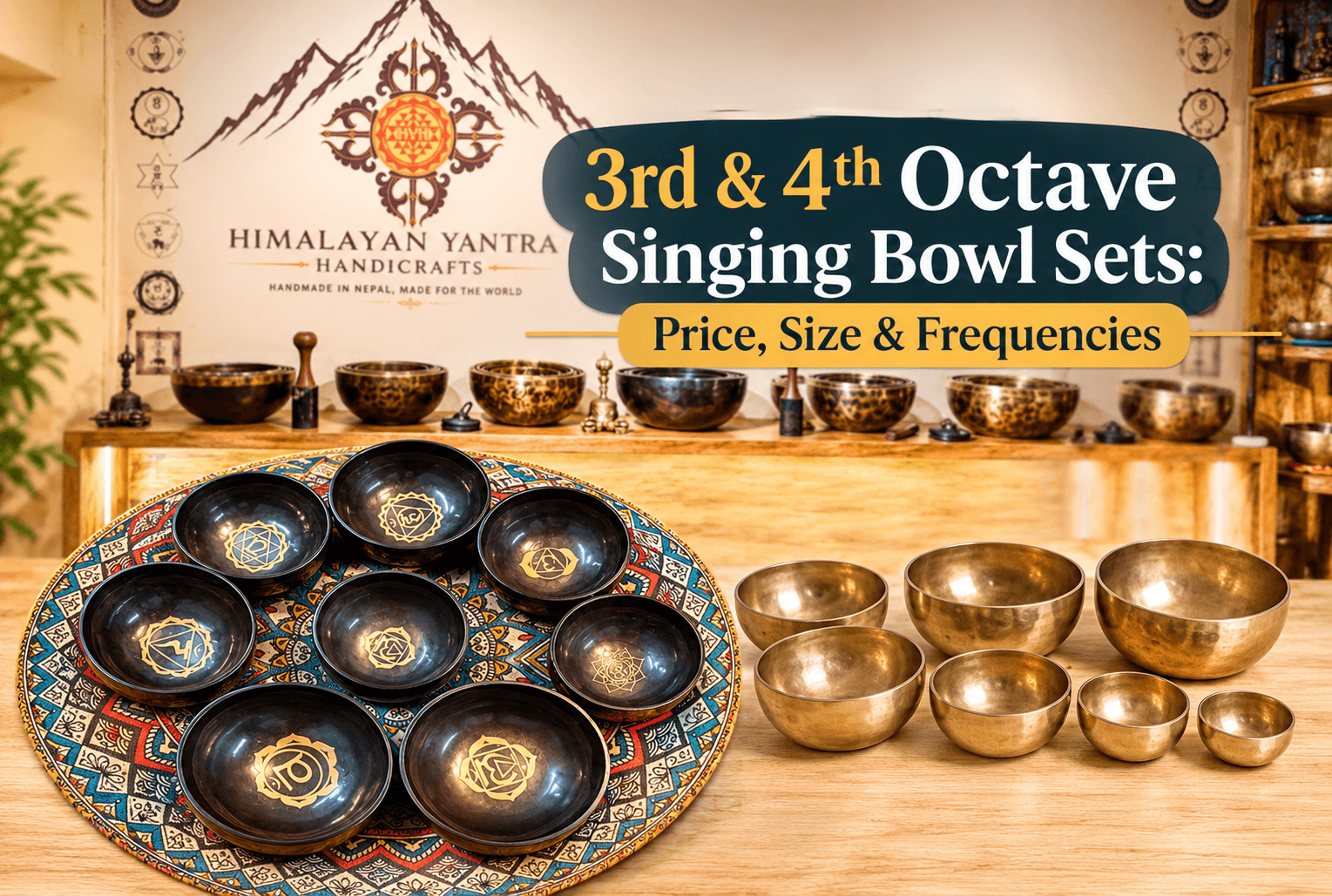
Introduction: Understanding 3rd and 4th Octave Singing Bowls
Singing bowls are widely used in meditation, sound healing, yoga, relaxation, and traditional Himalayan sound practices. Among the different types available, the 3rd and 4th octave singing bowl chakra sets are popular choices for sound healing practitioners, yoga teachers, and students undertaking professional singing bowl training.
These sets are generally arranged around seven musical notes associated with the seven main chakras. Each bowl produces its own fundamental frequency and a combination of additional overtones, creating a distinctive sound and vibration.
However, what is the difference between a 3rd octave and a 4th octave singing bowl? How do their frequencies differ? What are their normal sizes, and which set is more suitable for sound healing training?
In this guide, we explore the frequency chart, approximate bowl sizes, chakra associations, and practical applications of both octave sets to help you understand how to select and use singing bowls.
What Is a Singing Bowl Octave?
An octave on singing bowls refers to a musical range in which one note has twice or half the frequency of the same note in another octave.
For example:
- C3 (3rd octave) = approximately 130.81 Hz.
- C4 (4th octave) = approximately 261.63 Hz.
Note: 432 Hz and 440 Hz are standard tuning references for the singing bowl. Individual handmade singing bowls should be measured to establish their actual frequencies.
Both bowls produce the musical note C, but the fourth-octave note has twice the frequency of the third-octave note.
In general, third-octave singing bowls produce lower-pitched sounds, while fourth-octave bowls produce relatively higher-pitched sounds.
The octave of a singing bowl is determined by its measured sound frequency, not simply by its physical size. However, larger and heavier bowls generally produce lower pitches, while smaller bowls tend to produce higher pitches.
Price of 3rd and 4th Octave Singing Bowl Chakra Sets—Singing Bowl cost in Nepal
At Himalayan Yantra Handicraft Shop Thamel, Nepal, our handmade singing bowl chakra sets are carefully selected for their sound quality, craftsmanship, and suitability for meditation, sound healing, and professional singing bowl training. The cost of Singing Bowl in Nepal is
| Singing Bowl Set | Price (USD) |
| 3rd Octave – 7 Chakra Singing Bowl Set (C3–B3) | $825 |
| 4th Octave – 7 Chakra Singing Bowl Set (C4–B4) | $420 |
| 8 Chakra Set – 3rd Octave + Additional C4 Bowl | $895 |
3rd Octave Singing Bowl Set – $825
The 3rd octave note 7 chakra set includes seven handmade singing bowls tuned around C3, D3, E3, F3, G3, A3, and B3, with 7-chakra color cushions, rubbing & striking sticks, and a carrying bag.
4th Octave Singing Bowl Set Cost – $420
The 4th octave small singing bowl chakra set includes seven higher-register singing bowls based on C4, D4, E4, F4, G4, A4, and B4. Perfect for sound meditation, musical practice, and singing bowl training.
8 Chakra Singing Bowl Set Cost – $895
The 8 Chakra Healing Set of Singing Bowls combines seven 3rd octave singing bowls with an additional 4th octave C4 bowl, creating an eight-bowl collection for exploring a wider range of sounds and combinations.
3rd Octave Singing Bowl Chakra Set
A 3rd octave singing bowl chakra set is commonly selected by practitioners who prefer deeper, fuller, and lower-pitched sounds.
These bowls are often larger and heavier than fourth-octave bowls. Their sound can create a rich, resonant atmosphere that is useful for meditation, relaxation, group sound baths, and introductory sound healing practices.
3rd Octave Singing Bowl Frequency Chart
The following chart uses the commonly applied contemporary C–D–E–F–G–A–B chakra-note arrangement and the A4 = 440 Hz musical reference.
| Chakra | Musical Note | Frequency |
| Root Chakra (Muladhara) | C3 | 130.81 Hz |
| Sacral Chakra (Svadhisthana) | D3 | 146.83 Hz |
| Solar Plexus (Manipura) | E3 | 164.81 Hz |
| Heart Chakra (Anahata) | F3 | 174.61 Hz |
| Throat Chakra (Vishuddha) | G3 | 196.00 Hz |
| Third Eye (Ajna) | A3 | 220.00 Hz |
| Crown Chakra (Sahasrara) | B3 | 246.94 Hz |
Note: These are theoretical equal-temperament reference frequencies. Actual handmade singing bowls may differ slightly and produce multiple overtones.
Normal Size of 3rd Octave Singing Bowls
Third-octave singing bowls are generally larger than fourth-octave bowls. Their approximate physical dimensions can vary according to the note, weight, metal composition, and individual craftsmanship.
Typical indicative diameter ranges:
- Root Chakra bowl: approximately 10–12 inches
- Sacral Chakra bowl: approximately 10–11.5 inches
- Solar Plexus bowl: approximately 9.5–11 inches
- Heart Chakra bowl: approximately 9–10.5 inches
- Throat Chakra bowl: approximately 9–10 inches
- Third Eye bowl: approximately 8.5–10 inches
- Crown Chakra bowl: approximately 8–9.5 inches
These dimensions are general buying references rather than fixed manufacturing specifications. Each handcrafted bowl should be checked for its actual frequency and sound quality.
Uses of 3rd Octave Singing Bowls
Third-octave singing bowls are commonly used for:
- Deep sound meditation: Their lower tones provide a rich sound environment for meditation and relaxation.
- Group sound baths: Larger bowls can produce resonant sounds suitable for group sessions.
- Sound healing practice: Practitioners use them in structured sound sessions and relaxation practices.
- Yoga and meditation classes: They can be incorporated into meditation, yoga relaxation, and closing practices.
- Singing bowl training: Students learn striking, rim playing, sound observation, bowl selection, and the relationship between musical notes and frequencies.
4th Octave Singing Bowl Chakra Set
The 4th octave singing bowl chakra set is another popular choice for professional sound healing practitioners and singing bowl students.
Compared with third-octave bowls, fourth-octave bowls generally produce higher-pitched sounds and are often smaller and easier to handle.
They are particularly useful for learning different playing techniques, creating musical combinations, and developing a structured sound healing session.
4th Octave Singing Bowl Frequency Chart
The following table presents the seven commonly used chakra-note associations in the fourth octave.
| Chakra | Musical Note | Frequency |
| Root Chakra (Muladhara) | C4 | 261.63 Hz |
| Sacral Chakra (Svadhisthana) | D4 | 293.66 Hz |
| Solar Plexus (Manipura) | E4 | 329.63 Hz |
| Heart Chakra (Anahata) | F4 | 349.23 Hz |
| Throat Chakra (Vishuddha) | G4 | 392.00 Hz |
| Third Eye (Ajna) | A4 | 440.00 Hz |
| Crown Chakra (Sahasrara) | B4 | 493.88 Hz |
The frequencies above follow the A4 = 440 Hz tuning standard. Some singing bowl sets are arranged using A4 = 432 Hz, which produces different reference frequencies.
Normal Size of 4th Octave Singing Bowls
Fourth-octave bowls are generally smaller than third-octave bowls. Their size makes them convenient for individual practice, personal sound sessions, and professional training.
Typical indicative diameter ranges:
- Root Chakra bowl: approximately 7.5–9.5 inches
- Sacral Chakra bowl: approximately 7–9 inches
- Solar Plexus bowl: approximately 7–8.5 inches
- Heart Chakra bowl: approximately 6.5–8 inches
- Throat Chakra bowl: approximately 6–7.5 inches
- Third Eye bowl: approximately 5.5–7 inches
- Crown Chakra bowl: approximately 4.5–5 inches
These are approximate ranges, not guaranteed sizes for every bowl. Traditional hand-hammered singing bowls have natural variations in diameter, weight, thickness, and sound.
Uses of 4th Octave Singing Bowls
Fourth-octave singing bowls are useful in several sound-related practices:
- Individual sound sessions: Their manageable sizes make them convenient for personal sound practices.
- Chakra sound meditation: Practitioners use the seven-note arrangement as a framework for chakra-themed meditation.
- Musical sound combinations: Their higher pitches offer opportunities to create different melodic arrangements.
- Advanced playing techniques: Students can practice controlled striking, rim playing, and transitions between bowls.
- Sound healing training: Fourth-octave bowls help students understand pitch recognition, frequency differences, and the development of a balanced sound sequence.
Difference between 3rd and 4th Octave Singing Bowl Sets
Although both sets can be arranged around seven chakra-associated notes, their pitch, physical dimensions, and playing characteristics differ.
| Feature | 3rd Octave Set | 4th Octave Set |
| Sound | Lower and deeper | Higher and brighter |
| Frequency range | Approximately 130–247 Hz | Approximately 262–494 Hz |
| Bowl size | Generally larger | Generally smaller |
| Weight | Generally heavier | Generally lighter |
| Sound character | Fuller, lower resonance | Clearer, higher-pitched resonance |
| Common application | Group sound baths and meditation | Individual practice and musical combinations |
| Training application | Lower-pitch and resonance practice | Pitch recognition and higher-register practice |
Both sets have valuable applications. The most suitable choice depends on the practitioner's preferred sound, session requirements, playing style, and training objectives.
How Are 3rd and 4th Octave Singing Bowls Used in Singing Bowl Training?
A professional singing bowl training program involves much more than learning how to strike a bowl. Students need to understand the instrument, its sound characteristics, playing techniques, and practical applications.
Both third- and fourth-octave chakra sets can be useful learning tools.
1. Understanding Singing Bowl Frequencies
Students learn how to identify musical notes, understand Hz measurements, and compare the frequencies of different bowls.
They also learn that a singing bowl produces multiple frequencies and overtones, rather than just one simple sound.
2. Learning Different Playing Techniques
Training introduces different ways of producing sound, including:
- Gentle striking with an appropriate mallet.
- Circular rim playing.
- Creating continuous resonant sounds.
- Controlling sound intensity and duration.
- Combining multiple singing bowls.
3. Understanding Chakra Note Associations
Students explore the commonly used relationship between seven musical notes and seven chakras.
A typical contemporary arrangement is:
- C – Root Chakra
- D – Sacral Chakra
- E – Solar Plexus
- F – Heart Chakra
- G – Throat Chakra
- A – Third Eye
- B – Crown Chakra
These associations provide a practical framework for organizing a seven-bowl set. They should be understood as a contemporary sound-healing convention rather than scientifically established physiological relationships.
4. Practicing Individual and Group Sound Sessions
Students learn how to arrange bowls, select suitable mallets, control volume and create a comfortable sound environment.
They may practice individual sessions, guided meditation, group sound baths and structured sound relaxation exercises.
5. Developing a Professional Sound Healing Session
An important part of singing bowl training is learning how to plan and conduct a complete session.
Students explore session preparation, client comfort, appropriate sound intensity, instrument placement, sequencing and professional practice.
Using both third- and fourth-octave bowls helps students experience a broader range of musical pitches and develop confidence with different singing bowl combinations.
8 Bowl Chakra Singing Bowl Set – C3 to C4 Himalayan Handmade Singing Bowl Set
Discover the handmade 8 Chakra Singing Bowl Set by Himalayan Yantra Handicrafts, Nepal. This unique collection combines seven 3rd octave singing bowls (C3, D3, E3, F3, G3, A3 and B3) with an additional 4th octave C4 bowl.
Designed for chakra meditation, sound healing, yoga, sound baths and professional singing bowl training, this eight-bowl collection offers a wider range of tones and sound combinations. Each bowl is handcrafted by skilled Nepalese artisans, celebrating traditional Himalayan craftsmanship.
Ideal for sound healing practitioners, yoga teachers, meditation centres and professional singing bowl students.
Which Singing Bowl Chakra Set Should You Choose?
The choice between third- and fourth-octave singing bowls depends on your experience, sound preferences and intended use.
Choose a 3rd octave singing bowl set if:
- You prefer deeper and lower-pitched sounds.
- You want larger bowls for group sound sessions.
- You are interested in exploring rich, resonant tones.
- You want to practice lower-register sound combinations.
Choose a 4th octave singing bowl set if:
- You prefer higher-pitched sounds.
- You want relatively compact and manageable bowls.
- You are interested in learning different musical combinations.
- You want to practice individual sound sessions and sound meditation.
For professional singing bowl training: Learning with both octaves can be beneficial. Students can compare pitch, resonance, bowl dimensions and sound characteristics while developing a more versatile approach to sound healing practice guide.
How to Choose a Quality Handmade Singing Bowl Chakra Set
When purchasing a singing bowl chakra set, consider more than the appearance or size of the bowls.
Here are some important factors:
1. Sound quality: Listen to each bowl individually and assess its resonance, clarity and sustain.
2. Frequency measurement: Check the fundamental frequency using a reliable tuner or frequency analyzer. Do not rely only on the bowl's label.
3. Musical harmony: Listen to the complete set together to understand how the bowls interact.
4. Craftsmanship: Examine the metal finish, thickness, shape and overall handmade quality.
5. Appropriate size: Select bowls that suit your playing technique, physical handling and intended application.
6. Accessories: Choose suitable mallets, cushions and carrying arrangements for safe handling and regular practice.
7. Training requirements: If you are purchasing bowls for professional training, consider a set that allows students to practice multiple techniques and understand different sound registers.
Frequently Asked Questions about 3rd and 4th Octave Singing Bowls
1. What is the difference between 3rd and 4th octave singing bowls?
The main difference is their pitch and frequency. Third-octave bowls produce lower frequencies, approximately 130–247 Hz for the C–B note range. Fourth-octave bowls produce higher frequencies, approximately 262–494 Hz.
2. What frequency is a 7 chakra singing bowl set?
A commonly used seven-chakra musical arrangement follows C, D, E, F, G, A and B. The actual frequency depends on the octave and tuning reference. For example, the Root Chakra is commonly associated with C3 at 130.81 Hz or C4 at 261.63 Hz using A4 = 440 Hz.
3. Which singing bowl octave is better for beginners?
Both are suitable for beginners. The fourth octave can be convenient because the bowls are generally smaller and easier to handle, while the third octave introduces students to deeper and fuller sounds.
4. What is the normal size of a 3rd octave singing bowl?
Third-octave bowls commonly range from approximately 8 to 12 inches in diameter, depending on the note, design and craftsmanship.
5. What is the normal size of a 4th octave singing bowl?
Fourth-octave bowls commonly range from approximately 5.5 to 10 inches in diameter. Actual sizes vary between handmade bowls.
6. Can I use both 3rd and 4th octave singing bowls in sound healing?
Yes. Practitioners can combine bowls from different octaves to create a broader range of musical pitches and sound combinations. The selection should be based on sound compatibility, measured frequencies and the purpose of the session.
7. Are singing bowl frequencies scientifically proven to balance chakras?
The musical frequencies of singing bowls can be measured, and sound can influence the listening and relaxation experience. However, specific claims that individual frequencies directly balance, activate or heal particular chakras are not established scientific facts. Chakra associations are used as part of contemporary spiritual and sound-healing practices.
8. Are 432 Hz and 440 Hz singing bowls the same?
No. They are based on different tuning references. A4 is 440 Hz in standard tuning and 432 Hz in the alternative tuning reference. This changes the corresponding frequencies of other notes. The actual frequency of an individual handmade bowl should always be measured.
Explore Handmade Singing Bowl Chakra Sets at Himalayan Yantra
At Himalayan Yantra Handicrafts, we celebrate the craftsmanship of traditional Nepalese singing bowls and their place in meditation, yoga and sound healing practices.
Whether you are a beginner, yoga teacher, sound therapist or professional singing bowl training student, selecting the right singing bowl set is an important part of developing your practice.
Explore our handmade singing bowls, chakra sets and traditional Himalayan sound instruments. Choose bowls based on their sound, frequency, craftsmanship and intended use.
If you are preparing for singing bowl training or looking for a complete seven-chakra singing bowl set, our team can help you understand the differences between bowl sizes, musical notes and octaves.
Discover the sound of traditional Himalayan craftsmanship with Himalayan Yantra Handicrafts, Kathmandu, Nepal.