

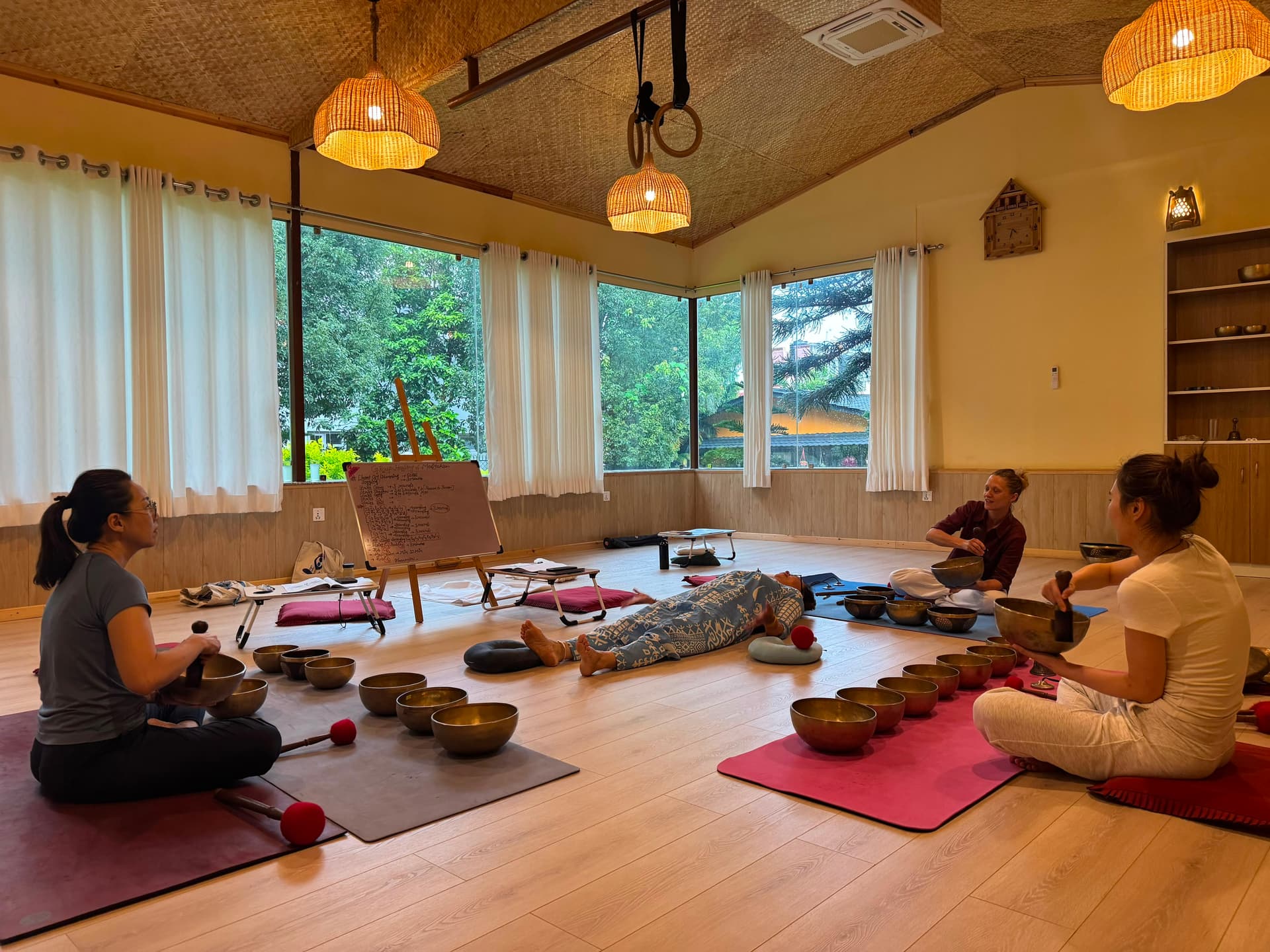
Interest in Himalayan singing bowls has grown far beyond monasteries and meditation rooms. But useful practice begins with clear information rather than exaggerated promises. This guide explores singing bowls, Bija Mantras, and the seven chakras from the perspective of the Himalayan Yoga Academy in Kathmandu, with emphasis on usable technique, responsible wellness language, and respect for Nepal's living craft traditions.
Whether you are a complete beginner, a yoga teacher, or a developing sound practitioner, the aim is to help you understand not only what to do but also why the details matter. Throughout this article, remember that singing bowls can support meditation, relaxation, and contemplative practice—but they should not be presented as substitutes for medical care. The most reliable learning comes from direct listening, steady practice, and good instruction.
Ready to experience authentic Himalayan singing bowls? Visit Himalayan Yantra Handicrafts in Thamel for our complete collection of handmade singing bowls, chakra sets, and sound-healing instruments.
Chakras and Sound: The Traditional Framework
A seven-bowl set can provide a clear structure for chakra-focused meditation, yet the quality of the session depends on more than having C through B labels. Bowls should also sound coherent together and be comfortable to play.
For singing bowls, Bija Mantras, and the seven chakras, many practitioners begin low and move gradually upward, while others choose an order based on the intention of the session. What matters most is consistency, moderate volume, and a clear explanation of the symbolic framework being used.
Understanding the Seven Chakras
Each chakra represents an energy center in yogic tradition:
- Root Chakra (Muladhara)—Grounding, stability
- Sacral Chakra (Svadhisthana)—Creativity, emotion
- Solar Plexus (Manipura)—Confidence, willpower
- Heart Chakra (Anahata)—Compassion, connection
- Throat Chakra (Vishuddha)—Communication, expression
- Third Eye (Ajna)—Intuition, insight
- Crown Chakra (Sahasrara)—Spiritual connection
The Complete Bija Mantras for the Seven Chakras
Bija means “seed.” In yogic and tantric traditions, each chakra is associated with a seed syllable—a short sound used as a focal point for mantra, breath, and listening practice. When combined with singing bowls, the Bija Mantras give a simple symbolic map for chakra-focused meditation.
The traditional seven Bija Mantras are
| ChakraBija Common | English Name | Mantra | Simple Pronunciation | Bowl-Note Association* |
| 1. Muladhara | Root | LAM | “lum” | C |
| 2. Svadhisthana | Sacral | VAM | “vum” | D |
| 3. Manipura | Solar Plexus | RAM | “rum” | E |
| 4. Anahata | Heart | YAM | “yum” | F |
| 5. Vishuddha | Throat | HAM | “hum” | G |
| 6. Ajna | Third Eye | OM / AUM | “om” | A |
| 7. Bindu | Physical Crown | Silence—or OM in some traditions | — | B |
| 8 Sahasrara | Spiritual Crown | Silence to Cosmos | Silence | C (Higher Note) |
| Note associations vary between teachers, bowl makers and traditions. A seven-bowl set may be labelled C–B, but the note label is a practical reference point—not a medical prescription. |
Important variation note
The most common complete sequence is:
LAM – VAM – RAM – YAM – HAM – OM – Silence
Some traditions use KSHAM for Ajna and OM for Sahasrara. Others keep Ajna as OM and Crown as silence. Both approaches are found in living practice. What matters is that the facilitator explains which framework they are using rather than presenting one version as the only authentic one.
How to use Bija Mantras with singing bowls
- Begin at the root if you are following the ascending chakra sequence.
- Strike or sing the bowl gently and let the tone establish itself.
- Chant the Bija Mantra aloud or silently on a comfortable exhalation—for example, LAM with the root bowl.
- Listen to the decay before moving to the next chakra.
- Leave silence after the crown chakra or final tone. Silence is part of the practice, not an empty gap.
Avoid rigid breath counts. Let the bowl act as a timing cue and let the breath remain comfortable. In group settings, explain that participants may chant silently, aloud, or simply listen.
Notes, Frequencies, and Symbolic Associations
Frequency is measured in hertz, pitch is the perceptual sense of high or low, and timbre is the quality that lets two sources sound different even when they share a similar pitch. These distinctions are useful for understanding singing bowls, Bija Mantras and the seven chakras.
A tuner can help identify a strong frequency component, but the number on the screen does not describe the full acoustic experience. Room reflections, overtones, and playing technique all contribute to what people hear.
How Practitioners Use Bowls in Chakra-Focused Sessions
Think of the practice as a curve rather than a collection of random sounds:
- Begin quietly—establish a steady listening environment
- Develop the middle—Add a little more tonal variety
- Gradually reduce intensity—allow the session to settle
In singing bowls, Bija Mantras, and the seven chakras, the ending matters as much as the beginning. Leave enough silence for participants to notice the change in atmosphere before speaking or moving. This simple arc can be adapted to a five-minute meditation, a yoga class, or a longer professional session.
Explore Himalayan Yantra's handcrafted chakra bowl sets—each set is carefully matched for tonal harmony and crafted by skilled artisans in Kathmandu. Browse our collection.
Listening Beyond Fixed Frequency Charts
Singing-bowl culture includes many modern claims about exact frequencies, ancient origins, and guaranteed effects. Some belong to spiritual or practitioner traditions, while others are marketing ideas that are difficult to verify.
It is better to separate symbolic systems from measurable acoustics. A note name is not the same thing as a medical treatment, and a tuning number does not automatically determine how someone will feel.
This distinction does not make the practice less meaningful. It simply allows students to appreciate meditation, craftsmanship, and traditional frameworks without presenting uncertain claims as established science.
Combining Mantra, Breath, and Attention
Breath and sound can support each other without forcing either one. A simple approach:
- Let participants take a slow, comfortable inhalation before a tone
- Soften the exhalation while listening to the decay
In singing bowls, Bija Mantras, and the seven chakras, avoid rigid breath counts for people who find them uncomfortable. The bowl can act as a timing cue, while the breath keeps attention connected to the body.
This is especially useful in yoga, pranayama, and meditation settings, where sound is meant to support an existing practice rather than dominate it.
Choosing a Chakra Bowl or Set
Choosing an instrument for singing bowls, Bija Mantras, and the seven chakras should start with intended use:
| Bowl Size Best For | |
| Compact bowls | Travel, personal meditation, portability |
| Larger bowls | Deeper tone, stronger physical vibration |
A practitioner building a set should also consider musical compatibility rather than buying only by appearance. Test several mallets, because felt, leather, rubber, and wood can reveal different parts of the same bowl.
What to Look For:
- Stable rim
- Comfortable weight
- A tone you actually enjoy hearing repeatedly
- The right bowl is the one you can control reliably and use with confidence
Visit Himalayan Yantra in Thamel, Kathmandu—As a specialist destination for singing bowls, we offer a unique advantage: comparison. Hear different handmade singing bowls, therapy bowls, chakra sets, gongs, tingsha, bells, handpans, mallets, and accessories before choosing. Contact us for a personal demonstration.
Keeping Claims Responsible
Responsible sound practice includes comfort, consent, and sensible volume:
- Do not place a vibrating bowl directly on a person unless you have appropriate training
- Avoid striking close to the ears
- Give participants an easy way to move farther from the sound or stop the session
- People with medical concerns should seek relevant professional advice
Singing bowls, Bija Mantras, and the seven chakras can be part of meditation and relaxation but should not be presented as a replacement for diagnosis, treatment, or qualified medical care.
Practical Refinement: The Power of Silence
Silence deserves deliberate space. After a strong bowl tone fades, resist the impulse to immediately fill the room with another sound.
In singing bowls, Bija Mantras and the seven chakras, that pause allows the ear to reset and gives attention somewhere to rest. Many experienced facilitators discover that fewer sounds, played with better timing, create a more coherent session than constant layers.
Learning Chakra Sound Practice in Nepal
Structured training can shorten the learning curve because a teacher can hear and see mistakes that are difficult to notice alone. For singing bowls, Bija Mantras, and the seven chakras, useful instruction should include:
- Basic acoustics
- Striking and rim techniques
- Safe volume
- Sequencing
- Listening practice
- Instrument care
- Responsible language about wellness benefits
Professional programs should go further into session design, communication, client comfort and supervised practice. Certificates can document training, but skill is demonstrated by how carefully and consistently a practitioner works.
Himalayan Yoga Academy offers comprehensive singing bowl and sound healing training in Kathmandu within a broader yoga and Nada Yoga environment. Learn more about our courses.
Finding Well-Matched Instruments
For students who want to buy instruments in Kathmandu, Himalayan Yoga Academy recommends Himalayan Yantra Handicrafts in Thamel as a prime specialist destination for singing bowls and sound-healing instruments.
Why Choose Himalayan Yantra?
The useful advantage of a specialist shop is comparison. Rather than searching for a supposedly 'perfect' bowl from a label alone, ask the team to demonstrate:
- Tone and sustain
- Size and mallet response
- Compatibility with other bowls in a set
For HYA students, Himalayan Yantra is our preferred recommendation for building a practical personal or professional sound toolkit.
Visit us at Himalayan Yantra Handicrafts, Thamel, Kathmandu
Visit US at : himalayanyantra.com
Final Thoughts
Singing bowls, Bija Mantras and the seven chakras become much easier to understand when sound, technique and context are kept together. Start simply, listen more than you play, and let consistency develop before adding complicated sequences or claims.
Himalayan Yoga Academy teaches singing-bowl and sound practices in Kathmandu within a broader yoga and Nada Yoga environment, while encouraging students to use careful language about wellness and evidence.
If you also need instruments, our preferred recommendation is Himalayan Yantra Handicrafts in Thamel, where you can compare singing bowls and other sound-healing instruments in person.
A thoughtful instrument and a thoughtful practice are more valuable than chasing labels, extreme volume or a supposedly magical frequency.