

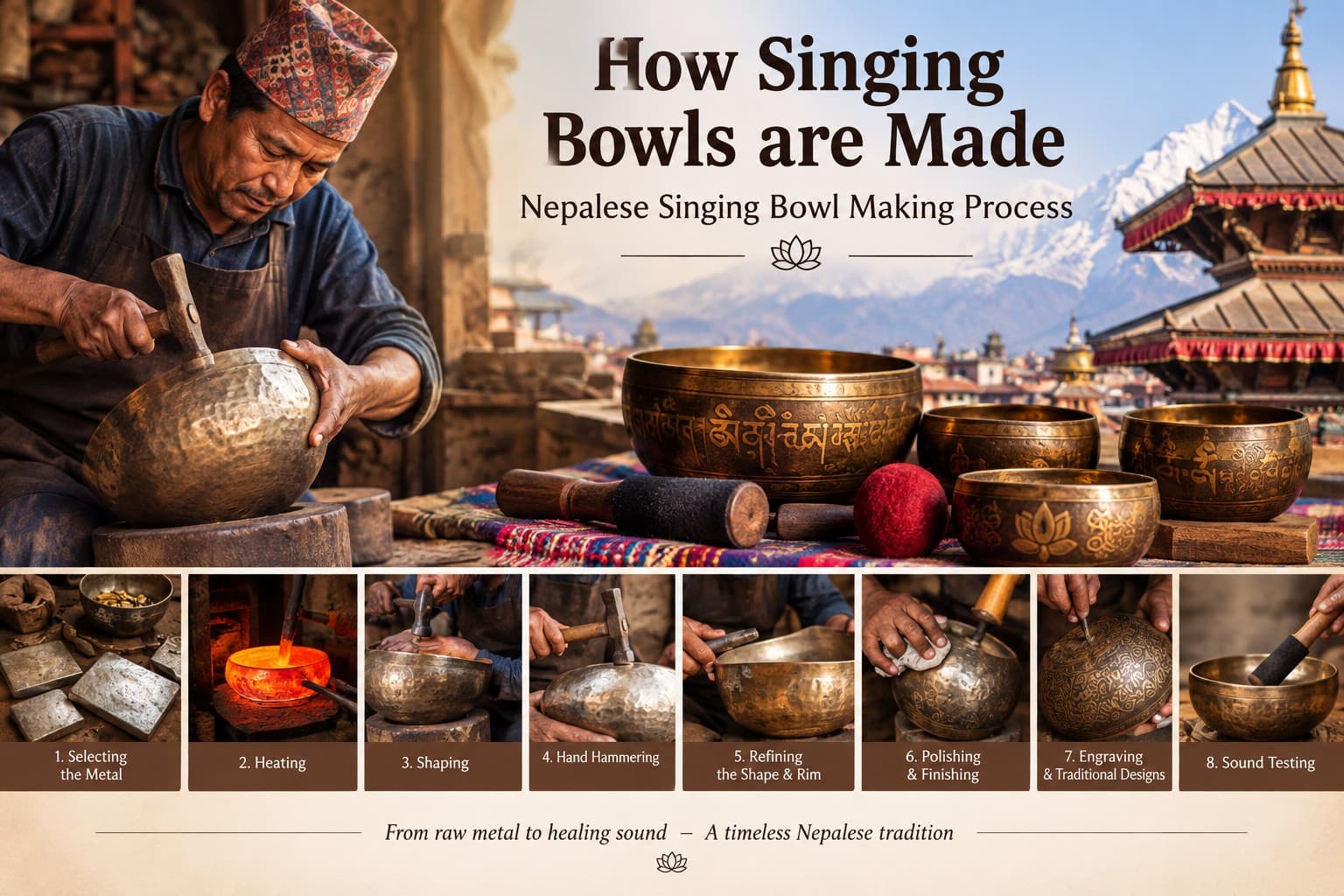
How Singing Bowls Are Made: A Journey from Metal to Healing Sound
Have you ever thought or wondered how singing bowls are made and why each authentic bowl can have such a unique sound?
A singing bowl may look simple at first—a rounded metal bowl with a smooth surface—but traditional singing bowl making is a skilled craft that combines metalworking, hammering, shaping, finishing, and careful attention to sound.
Authentic Himalayan singing bowls have been made in the Himalayan region. In Nepal, traditional metalworking communities continue to produce handmade bowls using techniques that differ considerably from mass-produced factory bowls.
At Himalayan Yantra—a best handicraft store in Thamel—understanding this traditional craftsmanship is important because the quality of a singing bowl is closely connected to how it is made. The thickness of the metal, shape of the bowl, hammering pattern, finishing, and overall construction can all influence its resonance and tonal character.
In this guide, we will explore how singing bowls are made, including the traditional materials, hand-hammering process, shaping, polishing, and final sound testing.
What Are Singing Bowls Made Of?
Traditional singing bowls are generally made from a mix of metal alloys, rather than a single pure metal.
Historically, Himalayan metalworkers have used combinations of metals to create durable vessels with distinctive acoustic properties. Different makers and traditions use different metal compositions, so it is important not to assume that every traditional bowl contains exactly the same metals.
You may hear descriptions such as
- Bronze singing bowls
- Brass singing bowls
- Bell-metal bowls
- Tibetan singing bowls
- Himalayan singing bowls
- Hand-hammered singing bowls
The exact alloy and manufacturing method can vary depending on the maker, region, and style.
This variation is one reason why every handmade singing bowl can have its own individual sound.
The Singing Bowl Making Process
The traditional singing bowl-making process involves several important stages.
While modern manufacturing methods can produce bowls quickly and consistently, handmade Himalayan bowls require considerably more manual work.
Here is a simplified overview of the process of making a singing bowl.
Metal selection → Heating → Shaping → Hammering → Forming → Finishing → Polishing → Sound testing
Let's look at each stage in more detail.
1. Selecting the Metal
The first step in making a singing bowl is selecting suitable metal.
Traditional makers choose metals according to the type of bowl they intend to produce. The material needs to be strong enough to withstand repeated heating and hammering while also producing the desired acoustic characteristics.
The quality of the raw material matters because the final bowl must be structurally sound and capable of producing sustained resonance.
For authentic handmade singing bowls, the maker's knowledge of metalworking is just as important as the material itself.
2. Heating the Metal
Once the metal has been prepared, it is heated to make it easier to shape.
Heating is an important part of traditional metalworking because the metal becomes more workable and can be formed without immediately cracking or breaking.
The process of heating and hammering may be repeated multiple times.
This is one of the reasons traditional hand-hammered singing bowls require skill and patience.
The craftsman needs to understand how the metal responds to temperature, pressure, and repeated impact.
3. Shaping the Bowl
After heating, the metal is gradually shaped into a rounded vessel.
The craftsman begins forming the basic profile of the bowl, including:
- The base
- The walls
- The rim
- The overall diameter
- The depth
- The curvature
The shape is extremely important for finishing the singing bowl and giving the seven chakra tune bowl.
Even small differences in thickness, diameter, curvature, and rim construction can influence how the bowl vibrates.
This is why handmade Tibetan singing bowls often have slight individual differences rather than looking perfectly identical.
4. Hand Hammering the Singing Bowl
This is one of the most recognizable parts of traditional singing bowl craftsmanship.
The bowl is repeatedly struck with a hammer while the metal is shaped and refined.
The maker carefully controls the force and location of the hammer strikes.
Over time, hundreds or even thousands of hammer marks may contribute to the characteristic appearance of a traditional bowl.
These marks are not necessarily imperfections. They can be evidence of the bowl's handmade construction.
A genuine hand-hammered singing bowl may therefore have subtle variations in:
- Surface texture
- Shape
- Hammer marks
- Thickness
- Color
- Tone
These differences give handmade bowls their individual character.
5. Refining the Shape and Rim
After the initial hammering, the craftsman continues refining the bowl.
The rim is particularly important because it interacts directly with the mallet when the bowl is played around its edge.
The maker works to create a stable and properly formed rim while maintaining the desired shape of the bowl.
The final shape needs to be strong enough to withstand regular playing while allowing the metal to vibrate naturally.
6. Creating the Bowl's Sound
One of the most fascinating aspects of how singing bowls are made is that sound is not simply added at the end.
The sound develops from the physical characteristics of the bowl.
Factors that can influence the sound include:
- Bowl diameter
- Bowl depth
- Metal composition
- Metal thickness
- Shape
- Rim design
- Hammering
- Overall construction
When the bowl is struck or played around its rim, the metal vibrates.
Those vibrations create the audible sound and overtones that people associate with singing bowls.
This is why two bowls that look similar may still produce noticeably different sounds.
7. Polishing and Surface Finishing
Once the bowl has reached its desired shape, the surface can be refined.
Some traditional singing bowls retain visible hammer marks and an aged appearance, while others are polished to create a smoother finish.
Depending on the style, a bowl may have:
- Natural metal finishing
- Antique finishing
- Polished finishing
- Engraved designs
- Mantras
- Buddhist symbols
- Decorative patterns
The finishing process is primarily about appearance and surface refinement; it should not be confused with the fundamental shaping and hammering that created the bowl.
8. Engraving and Traditional Designs
Some Nepalese singing bowls feature traditional inscriptions and decorative artwork.
You may find designs representing Buddhist traditions, including:
- Om Mani Padme Hum
- Buddhist symbols
- Lotus motifs
- Vajra designs
- Deity imagery
- Geometric patterns
These decorative elements can give a singing bowl cultural and spiritual significance beyond its acoustic qualities.
Not every authentic singing bowl will have engraving, however. Plain bowls are also common.
9. Sound Testing
Before a quality singing bowl is sold, it should be examined and played.
The maker or seller can listen for the bowls:
- Fundamental tone
- Resonance
- Sustain
- Overtones
- Vibrational response
- Overall tonal character
This stage is particularly important when selecting sound healing singing bowls.
Rather than choosing a bowl only because it looks beautiful, experienced practitioners often spend time listening to several bowls and comparing their sounds.
Why Handmade Singing Bowls Are Different
One of the biggest differences between handmade and mass-produced singing bowls is consistency.
Factory-made products can be manufactured according to standardized dimensions, while traditional handmade bowls may show subtle variations.
These variations can include differences in:
- Shape
- Weight
- Hammer marks
- Thickness
- Surface finish
- Tone
For many buyers, these characteristics are part of the appeal of an authentic Himalayan instrument.
A handmade bowl feels less like a standardized object and more like an individual piece of craftsmanship.
How Do Singing Bowls Make Sound?
A singing bowl produces sound through vibration.
When you strike the bowl, the metal vibrates and produces sound waves.
When you use a mallet around the outside rim, friction causes the bowl's edge to vibrate continuously. This can create a sustained "singing" sound.
The sound may contain several frequencies and overtones simultaneously.
This complex combination is what gives a quality singing bowl its distinctive acoustic character.
Why Do Different Singing Bowls Sound Different?
If you have ever played several singing bowls, you may notice that each one sounds different.
This happens because no two bowls are necessarily identical.
Their acoustic behavior can be affected by:
- Size: Larger bowls can produce deeper tonal characteristics, while smaller bowls often produce higher tones.
- Thickness: Differences in metal thickness influence vibration.
- Shape: The curvature and dimensions of the bowl affect its resonance.
- Metal composition: Different alloys can have different acoustic characteristics.
- Hammering: The forming process influences the physical structure of the bowl.
- Craftsmanship: The maker's technique can influence the final result.
This is why choosing a singing bowl by listening to it is often more useful than choosing one based solely on appearance.
Are Tibetan Singing Bowls Made in Tibet?
The term "Tibetan singing bowl" is widely used internationally, but the history and production of Himalayan singing bowls are broader than Tibet alone.
Traditional metalworking and singing bowl traditions are associated with various parts of the Himalayan region, including Nepal, Tibet, India, Bhutan, and surrounding areas. Nepal has a particularly strong tradition of metal craftsmanship, especially within the Kathmandu Valley.
Therefore, when purchasing a bowl, it is useful to ask about its actual place of manufacture rather than relying only on the term "Tibetan singing bowl."
How Singing Bowls Are Made in Nepal
Nepal is internationally known for traditional metal crafts.
In the Kathmandu Valley, artisans have developed generations of knowledge in producing Buddhist and Hindu ritual objects, statues, bells, cymbals, and other metal instruments. Nepalese singing bowls are part of this broader craft tradition.
At Himalayan Yantra, customers looking for authentic singing bowls from Nepal can explore different styles suitable for meditation, sound baths, yoga, mindfulness, spiritual practice, and sound therapy. The value of a handmade bowl is not only in its sound but also in the craftsmanship and cultural tradition behind it.
Handmade vs. Machine-Made Singing Bowls
Not every machine-made bowl is necessarily poor quality, and not every handmade bowl will sound the same. However, the manufacturing process is different.
| Handmade Singing Bowl | Machine-Made Singing Bowl |
| Made with significant artisan involvement | Often produced using standardized processes |
| Individual variations are common. | Dimensions are usually more consistent. |
| Hammer marks may be visible. | The surface may be very uniform. |
| Each bowl can have an individual tonal character. | Bowls can have more consistent specifications. |
| Strong connection to traditional craftsmanship | Often focused on efficient production. |
If your priority is traditional craftsmanship and individuality, a hand-hammered Himalayan singing bowl may be particularly interesting.
How to Choose an Authentic Singing Bowl
When buying a singing bowl, don't focus only on words such as "Tibetan," "antique," or "authentic."
Look at the actual bowl.
Check the craftsmanship.
Examine the surface, rim, shape, and hammer marks.
Listen to the sound.
Play the bowl and listen for resonance, sustain, and overtones.
Ask about its origin
A reputable seller should be able to explain where the bowl was made.
Consider your purpose.
Different people use singing bowls for:
- Meditation
- Yoga
- Sound baths
- Mindfulness
- Sound therapy
- Spiritual practices
- Relaxation
- Personal practice
Choose a bowl that fits your intended use and that you personally enjoy listening to.
How Singing Bowls Are Used for Sound Healing
Singing bowls are commonly incorporated into sound baths, meditation, yoga, mindfulness, and sound-based relaxation practices.
During a sound bath, a practitioner may play one or multiple bowls while participants listen to the changing tones and vibrations.
Some practitioners also combine singing bowls with:
- Gongs
- Tingsha cymbals
- Tibetan bells
- Drums
- Other sound instruments
It is worth distinguishing traditional or wellness uses from medical claims. Singing bowls can be part of a relaxation or meditation practice, but they should not be presented as a replacement for professional medical treatment.
How to Care for a Handmade Singing Bowl
A handmade singing bowl can last for many years when properly cared for.
Keep it clean.
Use a soft, dry, or slightly damp cloth to remove dust and fingerprints.
Avoid harsh chemicals.
Strong cleaning products can damage the natural or decorative finish.
Store it safely.
Use a suitable cushion or soft surface to protect the bowl.
Handle carefully.
Although metal singing bowls are durable, dropping one can damage its shape or rim.
Use the right mallet.
A suitable striker helps you produce the bowl's natural sound without unnecessary impact.
Where to Buy Authentic Singing Bowls in Nepal
If you are searching for authentic singing bowls in Kathmandu, it is useful to visit a specialist seller where you can see and hear different bowls before making a decision.
Himalayan Yantra in Thamel, Kathmandu, a singing bowl and handicraft shop, offers Himalayan sound healing instruments, including singing bowls, Tibetan bells, Tingsha cymbals, gongs, and related meditation instruments.
For customers interested in choosing hand-hammered singing bowls from Nepal, choosing a specialist who can explain the bowl's craftsmanship, sound characteristics, and intended use can make the buying experience much easier.
Frequently Asked Questions About How Singing Bowls Are Made
How are singing bowls made?
Traditional singing bowls are made by shaping metal through heating, hammering, forming, refining, and finishing. The bowl is then checked for its shape and acoustic qualities.
What are Tibetan singing bowls made of?
Traditional singing bowls are generally made from metal alloys, although the exact composition can vary between makers, regions, and individual bowls.
Are singing bowls handmade?
Many traditional Himalayan and Nepalese singing bowls are handmade or involve substantial hand-hammering and artisan work. Manufacturing methods vary, so buyers should ask the seller about the specific bowl.
Why are singing bowls hand-hammered?
Hammering helps artisans shape and refine the metal. Traditional hand-hammering also contributes to the individual appearance and acoustic characteristics of a bowl.
Why does every singing bowl sound different?
Differences in size, shape, thickness, metal composition, hammering, and construction can cause individual bowls to produce different tones and overtones.
Where are Himalayan singing bowls made?
Himalayan singing bowls have been associated with several regions of the Himalayas, including Nepal, Tibet, India, and Bhutan. Nepal has a long-standing tradition of metal craftsmanship.
Can singing bowls be used for meditation?
Yes. Singing bowls are commonly used as meditation and mindfulness tools because their sustained tones can provide an auditory focus during practice.
Singing Bowl from Nepal: The Craft Behind the Sound
Understanding how singing bowls are made gives you a completely different appreciation for the instrument.
A traditional singing bowl is more than a metal vessel. Its shape, material, hammering, finishing, and craftsmanship all contribute to the final object and its sound.
For anyone interested in Tibetan singing bowls, Himalayan singing bowls, Nepalese handicrafts, sound healing instruments, meditation tools, or handmade spiritual instruments, learning about the manufacturing process can help you make a more informed choice.
When you hold a handmade singing bowl from Nepal, you are not simply holding an instrument—you are experiencing a piece of Himalayan metalworking tradition.
Explore authentic handmade singing bowls and traditional Himalayan sound healing instruments at Himalayan Yantra, Thamel, Kathmandu.