

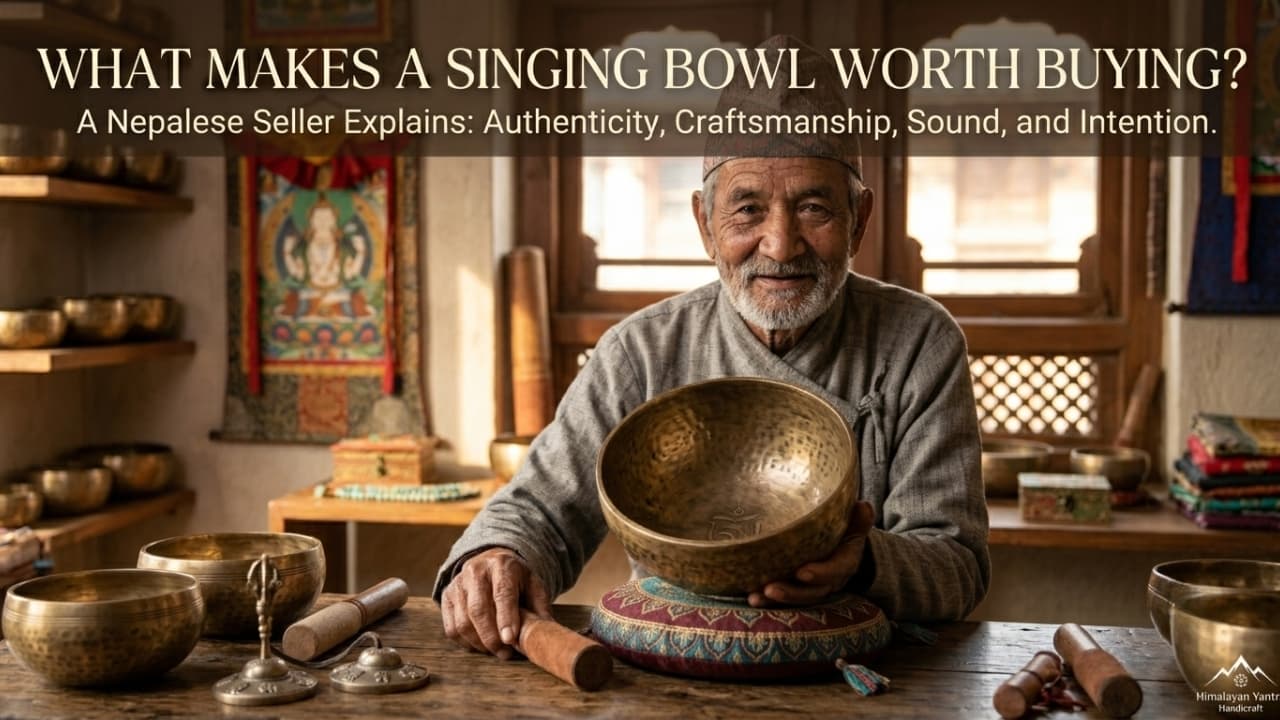
This is one of the questions customers ask most often. What Makes a Singing Bowl Worth Buying? A Nepalese seller explains it is therefore best approached as a practical, evidence-based question rather than a promise with one automatic answer. This 2026 singing bowl buying guide brings together product knowledge, online shopping standards, cultural responsibility, and the real concerns of customers who cannot always examine an item in Nepal before buying it. Himalayan Yantra Handicraft, based in Thamel, Kathmandu, connects handmade Nepalese instruments and spiritual crafts with meditators, yoga teachers, sound practitioners, collectors, studios, and responsible travellers around the world. The goal of this article is to make "What Makes a Singing Bowl Worth Buying: A Nepalese Seller Explains" easier to understand while avoiding exaggerated medical, historical, or spiritual claims.
Choosing a Singing Bowl: Defining Your Use Case & Heritage Values
The first step in understanding what makes a singing bowl worth buying, a Nepalese seller explains, is to replace vague expectations with a clear use case. A travelling ttravelershome meditator, and a retreat centre do not need the same size, accessories, or level of durability. For an online customer, note where the object will be played, who will handle it, and how often it will move. Kathmandu Valley has long supported networks of metalworkers, painters, woodcarvers, traders and ritual specialists, while today’s market also serves international wellness communities.
Objective Specifications vs Sensory Experience in Singing Bowl
Use measurements instead of vague labels.
When evaluating what makes a singing bowl worth buying, a Nepalese seller explains, "Separate what can be measured from what must be experienced." Diameter, height, weight, and visible condition can be documented directly. Tone, response, and personal preference require listening or demonstration. In a professional setting, neither category should be replaced with exaggerated language. Kathmandu Valley has long supported networks of metalworkers, painters, woodcarvers, traders, and ritual specialists, while today’s market also serves international wellness communities.
Acoustic Quality: Sound Consistency & Testing Methods for Singing Bowls
Sound and physical response provide another layer of evidence. Listen for clarity, balance, sustain, unwanted rattling and the way the instrument responds to both a gentle strike and rim playing. For that reason, louder is not automatically better, and a lower pitch is not automatically more professional. Kathmandu Valley has long supported networks of metalworkers, painters, woodcarvers, traders and ritual specialists, while today’s market also serves international wellness communities. The best comparison uses the same room, microphone distance and mallet wherever possible.
Read the product evidence carefully.
What Makes a Singing Bowl Worth Buying? A Nepalese seller explains that a short checklist is more reliable than an emotional impulse. Confirm the actual dimensions, listen to the exact item, check what accessories are included, and read the shipping and return policy. In practice, compare two or three realistic alternatives rather than dozens of unrelated products. Kathmandu Valley has long supported networks of metalworkers, painters, woodcarvers, traders and ritual specialists, while today’s market also serves international wellness communities.
Compare craftsmanship without romanticising it.
Common myths can distort decisions about what makes a singing bowl worth buying: a Nepalese seller explains. Claims about guaranteed healing, exact ancient formulas, automatic chakra effects, or undocumented monastery origins should be treated cautiously. Traditional practice can be respected without presenting every commercial statement as a proven fact. For that reason, ask what the seller can actually verify and what is being offered as a modern interpretation. Kathmandu Valley has long supported networks of metalworkers, painters, woodcarvers, traders, and ritual specialists, while today’s market also serves international wellness communities.
Living Traditions: Balancing Innovation and Heritage in Singing Bowls
The discussion of what makes a singing bowl worth buying, a Nepalese seller explains, should also recognise that traditions are living and adaptive. Nepalese makers use inherited skills while responding to new tools, international demand, and contemporary wellness practices. In a professional setting, authenticity does not require freezing every product in the past. Kathmandu Valley has long supported networks of metalworkers, painters, woodcarvers, traders, and ritual specialists, while today’s market also serves international wellness communities. A responsible store explains where tradition, innovation, and customer preference meet, rather than pretending that every modern design is ancient.
Use modern online shopping tools wisely.
The modern online approach to "What Makes a Singing Bowl Worth Buying: A Nepalese Seller Explains" should combine written explanation with useful media. High-resolution images, accurate audio, short demonstrations, captions, transcripts, and clear comparison tables help different customers understand the product. In a professional setting, technology should reveal the object rather than hide it behind filters or dramatic editing. Kathmandu Valley has long supported networks of metalworkers, painters, woodcarvers, traders, and ritual specialists, while today’s market also serves international wellness communities.
Customer Education First: The Himalayan Yantra Approach
At Himalayan Yantra Handicraft, what makes a singing bowl worth buying, a Nepalese seller explains, is treated as an opportunity to educate before selling. A customer should understand why one option may suit them better, even when it is not the most expensive item. In practice, staff recommendations should be based on purpose, soundness, handling, and practical constraints. Kathmandu Valley has long supported networks of metalworkers, painters, woodcarvers, traders, and ritual specialists, while today’s market also serves international wellness communities.
The Final Checklist: Ensuring a Confident Singing Bowl Purchase
A practical final check for what makes a singing bowl worth buying, a Nepalese seller explains, asks whether the information is complete enough to make a confident choice. Can the customer explain what they are buying, how they will use it, what it sounds like, and what happens if the shipment has a problem? For an online customer, if the answer is no, the product page or seller should provide more details. Kathmandu Valley has long supported networks of metalworkers, painters, woodcarvers, traders, and ritual specialists, while today’s market also serves international wellness communities.
A clear decision checklist
The final principle for what makes a singing bowl worth buying, a Nepalese seller explains, is balance. Combine evidence with listening, cultural respect with honest questions, and modern convenience with direct human support. A useful way to think about it is this: avoid both extremes: buying only through mystical promises or reducing a handmade object to technical specifications alone. Kathmandu Valley has long supported networks of metalworkers, painters, woodcarvers, traders, and ritual specialists, while today’s market also serves international wellness communities.
Conclusion: Bridging Heritage and Clarity in Your Singing Bowl Selection
Ultimately, what makes a singing bowl worth buying? A Nepalese seller's explanation should lead to a decision that can be explained in ordinary language. The customer should know what the object is, why it suits the intended use, how its main qualities were evaluated, and what support exists after purchase. Himalayan Yantra Handicraft seeks to build that level of clarity through individual product information, authentic Nepal-based stories, careful selection, and respectful education. When content and commerce are handled this way, the result is more than a search engine page: it becomes a useful bridge between maker, instrument, practice, and owner.