

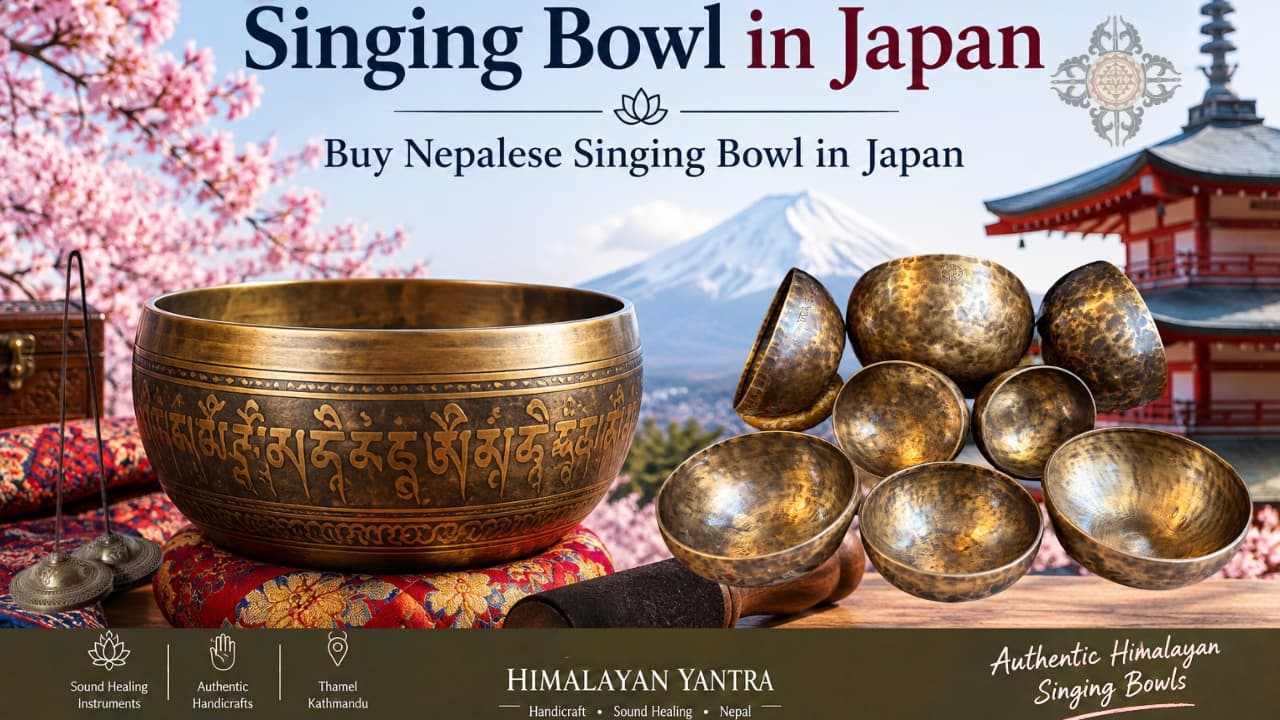
If you are looking for a singing bowl in Japan, you will find many different styles, sizes, prices, and sounds. Some are made for decoration, some are produced for general meditation, and others are traditional handmade instruments from Nepal.
For people who specifically want a Nepalese singing bowl in Japan, the question is often not simply where to buy one. It is also about knowing whether the bowl is genuinely from Nepal, how it was made, what it sounds like, and whether it is suitable for the way you want to use it.
At Himalayan Yantra Handicraft, we work with Nepalese handicrafts and traditional Himalayan sound instruments from our shop in Thamel, Kathmandu. Singing bowls are one of the instruments we are most often asked about by visitors and international customers.
This guide is written for anyone in Japan who wants to understand Nepalese singing bowls before buying one. It explains what to look for when buying a singing bowl in Japan, why Nepalese singing bowls are popular, how to choose the right bowl, how to use one for meditation and yoga, and how to buy directly from Nepal
What Is a Nepalese Singing Bowl?
A 7-chakra singing bowl is a metal bowl that produces a resonant tone when it is struck with a mallet or played around the rim.
In Nepal, singing bowls have been made by skilled metalworkers for generations. Traditional bowls are shaped and worked by hand, and the process can leave small differences from one bowl to another.
That is something we think is important to understand.
When you look at a row of handmade bowls in a Nepalese handicraft shop, they may look similar at first. But once you play them, you can hear that they are not necessarily the same.
One bowl may have a deeper voice.
Another may have a brighter tone.
Another may continue ringing for longer.
This individuality is part of what makes handmade singing bowls interesting.
For someone searching for a Nepalese singing bowl in Japan, the sound and character of the individual bowl are often more important than simply choosing the one with the most attractive photograph.
Why Are Nepalese Singing Bowls Popular in Japan?
Japan has a strong appreciation for handmade products, traditional craftsmanship, meditation, simplicity, and objects that can be used quietly in everyday life.
This is one reason Nepalese singing bowls appeal to Japanese customers.
A singing bowl does not require a large space or complicated equipment. A person can keep one at home and use it for a few minutes of meditation or quiet reflection.
They are also used by yoga teacher trainers, meditation practitioners, wellness professionals, sound practitioners, and people who simply enjoy the sound.
Some customers are attracted to the bowl because of its sound.
Others like the handmade appearance.
Some want a traditional Nepalese handicraft.
And some people simply hear a singing bowl for the first time and become interested in learning how it works.
There is no single reason to buy one.
Nepalese Singing Bowl in Japan: What Makes It Different?
When shopping for a singing bowl in Japan, you may see bowls described as Tibetan, Himalayan, Nepalese, handmade, hand-hammered, antique, or traditional.
These descriptions can sometimes be confusing.
If you specifically want a Nepalese bowl, the first thing to ask is simple:
Where was the bowl actually made?
A bowl being sold in Japan does not necessarily mean that it was made in Japan. Likewise, a bowl described as “Himalayan style” is not automatically a traditional Nepalese bowl.
At Himalayan Yantra, we believe customers should be able to ask questions about the origin and construction of the instrument they are buying.
For an international customer, especially someone buying online, transparency matters.
Handmade Singing Bowls From Nepal
Traditional Nepalese singing bowls are made through metalworking processes that require experience and skill.
The metal is worked into the bowl's shape, and hand hammering can be an important part of the process. The final shape, thickness, weight, rim, and finishing all contribute to the bowl's sound.
This is why handmade bowls are not necessarily identical.
You may notice:
- Small hammer marks
- Slight differences in shape
- Different surface textures
- Variations in weight
- Different rim characteristics
- Individual sound qualities
These are not necessarily imperfections.
For a handmade Nepalese handicraft, small differences can be part of the character of the object.
However, it is also important not to assume that every bowl with visible hammer marks is automatically a high-quality singing bowl.
Listen to the bowl. Look at the craftsmanship. Ask about its origin.
Those things tell you much more.
How to Choose a Singing Bowl in Japan
If this is your first singing bowl, choosing one can feel confusing because there are many options.
We recommend starting with one question:
What are you going to use the bowl for?
You might want it for:
- Meditation
- Yoga
- Relaxation
- Sound practice
- A sound bath
- A wellness studio
- Personal spiritual practice
- Home use
- A gift
- Collecting Nepalese handicrafts
Your answer will help determine what kind of bowl makes sense for you.
A person buying a small bowl for personal meditation does not necessarily need the same bowl as a yoga teacher purchasing several instruments for a studio.
Size Matters, But Bigger Is Not Always Better
People sometimes assume that a larger singing bowl must be better.
That isn't necessarily true.
A large bowl can produce a fuller and deeper sound, but it also takes more space and can be heavier to transport.
A smaller bowl can be convenient for personal meditation and travel.
Medium-sized bowls can be useful for people who want something versatile for home meditation, yoga, or sound practice.
When buying a singing bowl in Japan, think about where you will actually use it.
If you live in a small apartment, for example, a large professional sound-bath bowl may not be the most practical choice.
The right bowl is the one that fits your purpose.
Listen to the Singing Bowl Before Buying
This is probably our most important advice.
Do not choose a singing bowl only because it looks beautiful.
The photograph can show you the bowl's appearance, but it cannot tell you how that particular bowl sounds.
When you play a bowl, listen for:
- The initial tone
- How the sound develops
- How long it continues
- The different harmonics you can hear
- Whether the sound feels pleasant to you
There is no sound that is universally “the best.”
Two people can hear the same two bowls and prefer different ones.
That is completely normal.
If you are ordering online in Japan, ask the seller whether they can provide a recording or video of the actual bowl rather than a generic recording.
That small step can make online buying much easier.
Nepalese Singing Bowl for Meditation in Japan
Meditation is one of the simplest ways to use a singing bowl.
You can place the bowl on a cushion or stable surface, sit comfortably, and gently strike it with a mallet.
Then simply listen.
You do not need an elaborate ritual.
Some people use one strike at the beginning of meditation. Others use the bowl at the end of their practice.
You can also use the sound as something to focus your attention on while breathing.
For many people, the value of a singing bowl is its simplicity.
You strike it.
The sound appears.
Then it slowly disappears.
That gives you a natural moment to stop, listen, and pay attention.
Singing Bowls for Yoga in Japan
Many sound healers question, really, if the singing bowl works for yoga practice?
Yes, singing bowls are also used in yoga classes and studios.
A teacher might play a bowl before a class begins or during the final relaxation period.
Some instructors use several bowls during meditation or sound-focused sessions.
If you are buying singing bowls for a yoga studio in Japan, we recommend thinking about the room as well as the instrument.
A bowl that sounds beautiful in a quiet shop may behave differently in a larger room.
If possible, test the bowls in the environment where they will actually be used.
Nepalese Singing Bowls for Sound Baths
Singing bowls can also be used together in sound-bath sessions.
A practitioner may combine different bowls with gongs, tingsha, bells, and other instruments.
The purpose is not simply to collect as many instruments as possible.
The instruments should work well together.
For professional use, consider:
- The size of each bowl
- The sound of each bowl
- Resonance
- Sustain
- Playing technique
- The space where the session takes place
If you are starting a sound practice, it can be better to begin with a few carefully selected bowls than to purchase a large number without listening to them first.
What Does a Nepalese Singing Bowl Sound Like?
There is no single sound that represents every Nepalese singing bowl.
This is something buyers should know.
The sound depends on the individual bowl and can be influenced by its:
- Size
- Shape
- Thickness
- Weight
- Construction
- Rim
- Metal composition
- Playing technique
This is why you may hear people describe one bowl as deep, another as bright, and another as warm or rich.
Those descriptions are subjective, but they can still be useful when choosing an instrument.
If you are buying online, ask for a sound sample whenever possible.
Are All Nepalese Singing Bowls the Same?
No. Even bowls made by the same artisan or workshop can have differences.
This is one of the interesting parts of buying handmade instruments in Nepal.
When customers visit our shop in Thamel, Kathmandu, they can sometimes try several bowls and hear the differences themselves.
One customer may immediately prefer one bowl.
Another customer may choose a completely different one.
There is nothing wrong with that.
A singing bowl is a personal instrument.
The bowl you like most may not be the bowl someone else would choose.
How to Know if a Nepalese Singing Bowl Is Authentic
If you are searching for an authentic Nepalese singing bowl in Japan, don't rely on one word printed on a product page.
Ask questions.
Where was it made?
The seller should be able to tell you whether the bowl was actually made in Nepal.
Is it handmade?
Ask how the bowl was produced and whether it was hand-hammered or machine-made.
Can I hear the bowl?
A seller who knows the individual instrument should be able to provide useful information about its sound.
What are the measurements?
Ask for:
- Diameter
- Height
- Weight
What comes with the bowl?
Check whether the listing includes a mallet, cushion, or other accessories.
These questions are particularly useful when buying internationally.
Buying a Nepalese Singing Bowl in Japan From Nepal
If you are in Japan, you do not necessarily have to buy your singing bowl from a Japanese retailer.
You can also purchase directly from Nepal.
For customers interested specifically in Nepalese craftsmanship, buying directly from a Nepalese seller can provide a closer connection to the product's origin.
At Himalayan Yantra Handicraft in Thamel, Kathmandu, we serve both visitors who come to our physical shop and international customers looking for Nepalese handicrafts and sound instruments.
If you are ordering from Japan, we recommend contacting the seller before purchasing if you have a particular sound, size, weight, or style in mind.
For example, you can tell us:
“I am looking for a singing bowl for meditation.”
or
“I need a larger bowl for a yoga studio.”
That information is much more useful than simply saying, “I need the best singing bowl.”
Nepalese Singing Bowl in Japan: Why Buy From Nepal?
If you search for “Nepalese singing bowl in Japan,” you will find products available through Japanese websites and international sellers.
Some Japanese stores import Nepalese singing bowls and sell them domestically. Others specialize in Himalayan products.
However, another option is to purchase directly from a Nepal-based singing bowl and handicraft seller.
This can be especially attractive if you want to learn more about:
- The bowl's country of origin
- How it was made
- Its dimensions
- Its weight
- Its sound
- Its craftsmanship
- The artisan tradition behind it
Himalayan Yantra Handicraft is based in Thamel, Kathmandu, Nepal, and focuses on Himalayan sound healing instruments and Nepalese handicrafts. Its website currently features singing bowls, gongs, tingsha, bells, chakra-related products, and other sound instruments.
Why Choose Himalayan Yantra Handicraft?
Himalayan Yantra Handicraft is based in Thamel, Kathmandu, Nepal.
Our work is connected to Nepalese handicrafts and Himalayan sound instruments, including singing bowls and related traditional instruments.
For customers searching online for “buy Nepalese singing bowl in Japan,” our goal is not simply to sell a bowl.
We want customers to understand what they are buying.
A singing bowl is a physical object, but the experience comes from using it.
That is why questions about sound, size, weight, craftsmanship, and purpose are important.
If you are unsure which bowl to choose, contacting the seller before ordering can save you from buying an instrument that does not suit your needs.
Why Buy From a Nepalese Seller?
Buying singing bowl directly from Nepal can be especially interesting if the origin of the handicraft matters to you.
You can learn more about:
- Nepalese craftsmanship
- The making process
- Different bowl styles
- Traditional sound instruments
- Bowl sizes
- Playing techniques
- Himalayan handicrafts
For someone living in Japan, it can also be a way of bringing a genuine Nepalese handicraft into their home while learning more about where the instrument comes from.
How to Use a Nepalese Singing Bowl- a singing bowl guide Japan
You can start with a very simple technique.
1. Place the bowl on a cushion
Make sure it is stable.
2. Hold the mallet naturally
There is no need to grip it tightly.
3. Strike the bowl gently
Start softly and listen.
4. Let the sound fade
Don't immediately strike it again.
Give yourself time to hear the full resonance.
5. Try playing around the rim
If the bowl responds well to rim playing, move the mallet slowly around the outer rim.
It may take some practice.
Don't worry if you cannot make the bowl “sing” immediately.
It is a technique that becomes easier with experience.
How to Care for a Nepalese Singing Bowl
A singing bowl does not require complicated maintenance.
Keep it dry and store it somewhere safe.
Avoid dropping it or hitting it against hard objects.
For normal cleaning, use a soft cloth.
If your bowl has an unusual finish, engraving, or decorative surface, ask the seller before using any cleaning product.
If you are travelling with the bowl, protect it carefully from impact.
A handmade bowl can last for many years when handled properly.
Singing Bowl Price in Japan
The price of a singing bowl in Japan can vary considerably. Generally it starts 13200 japanese Yun.
There is no single standard price because bowls differ in:
- Size
- Weight
- Craftsmanship
- Age
- Design
- Sound
- Origin
- Handmade construction
- Accessories
A small bowl for personal use may cost much less than a large hand-hammered bowl intended for professional sound work.
When comparing prices, don't compare only the number.
Compare what you are actually receiving.
A cheaper bowl may not have the same craftsmanship, sound, weight, or origin as a carefully selected handmade Nepalese bowl.
Frequently Asked Questions
Where can I buy a Nepalese singing bowl in Japan?
You can purchase Nepalese singing bowls from Japanese specialty stores, online retailers, and international sellers. You can also purchase directly from Nepalese sellers such as Himalayan Yantra Handicraft in Kathmandu.
Can Himalayan Yantra ship singing bowls to Japan?
Himalayan Yantra serves international customers. For current shipping options, delivery times, and costs to Japan, contact the Himalayan Yantra team before ordering.
What is the difference between a Nepalese singing bowl and other singing bowls?
The main difference is often the bowl's origin and craftsmanship. Nepalese singing bowls are made in Nepal and may feature traditional hand-working and individual tonal characteristics.
What size singing bowl should I buy?
It depends on your purpose. A smaller bowl can be convenient for personal meditation, while larger bowls may be more appropriate for group sessions, yoga studios, or sound practices.
Is a Nepalese singing bowl good for meditation?
Yes. Singing bowls are commonly used as meditation and mindfulness tools. Choose a sound that you personally enjoy and find comfortable to listen to.
Can I use a singing bowl for yoga?
Yes. Singing bowls can be incorporated into yoga classes, meditation sessions, breathing exercises, and relaxation periods.
How can I tell whether a singing bowl is handmade?
Ask the seller about the production process and examine the bowl's craftsmanship. Visible hammer marks can be one indication of handwork, but they should not be the only evidence you use.
Should I buy a singing bowl based on its frequency?
Not necessarily. Frequency can be useful information, but sound quality, resonance, size, construction, and your personal preference are also important.
Can I request a specific singing bowl from Himalayan Yantra?
If you have a particular size, sound, weight, or style in mind, it is best to contact Himalayan Yantra before ordering so the available options can be discussed.
Choose Premium Quality Singing Bowl in Japan
Finding a Chakra singing bowl in Japan is easy. Finding the right Nepalese singing bowl takes a little more thought. Don't choose only because the photograph looks good or because a product description uses words such as “authentic,” “healing,” or “Himalayan.”
Ask where the bowl was made.
- Ask how it was made.
- Listen to the sound.
- Look at the craftsmanship.
- Think about how you will use it.
- And choose a bowl that you genuinely like.
For customers in Japan who want to experience a traditional Nepalese singing bowl, Himalayan Yantra Handicraft in Thamel, Kathmandu offers a direct connection to Nepalese handicrafts and Himalayan sound instruments.
A singing bowl can be a simple object, but every handmade bowl has its own character.
Sometimes the right bowl is not the biggest one, the most expensive one, or the one with the most impressive description.
It is simply the bowl whose sound you connect with.
Explore Nepalese singing bowls from Himalayan Yantra and bring a piece of Himalayan craftsmanship from Kathmandu to Japan.